


Dr Harvey Brown, 2025. What does it mean to be a CAT-informed Psychiatrist?
My current timetable stipulates that I work as a therapist on a Thursday morning, seeing two clients for CAT as well as having supervision, and as a Liaison Psychiatrist in the afternoon, dealing with a wide array of crises related to mental and physical health. This presents, what may seem on the surface, a trivial conundrum; do I wear scrubs to see my CAT clients, or do I wear my therapist outfit (nice corduroy shirts, black boots), to walk around a big chaotic hospital full of sick people? This dilemma is symbolic of the challenge that I face in straddling two modes of working, which deviate significantly in culture, ethos and methods. I have seen clients who invite me to diagnose them in therapy sessions, which I resist. Perhaps they would rather see me in scrubs. Equally I have seen patients on the 9th floor of a hospital in a bustling ward, who could really benefit from therapy.
Clothing isn’t the only dilemma. There is also a language problem. I see clients and patients in the same day and must make sure not to confuse the two terms. For the purposes of this essay, I will refer to people in the care of mental health services as patients, (unless directly referring to clients who I have seen for CAT) since this is how they are known in psychiatry, as I reflect from my position as a psychiatrist. The difference in terms is significant, with the term ‘client’ empowering, and the term ‘patient’ potentially disempowering and suggestive of a ‘sick person.’ The use of ‘medical jargon’ can perhaps create sense of difference and alienation, a doubting of a patient’s own feelings and interpretations, and for some, this sense of feeling unvalued or not listened to can feel all too familiar as I will touch on later in the article.
Negative Capability
First coined by John Keats in an 1817 letter, Negative Capability was described as the ability to accept “uncertainties, mysteries, doubts, without any irritable reaching after fact and reason.” (Gunderman,2021). Displaying negative capability is thus the opposite of a didactic approach, and one that is recognisable in the non-expert position and collaborative approach of a CAT therapist. In lacking this ‘negative capability’ psychiatric treatments can have inherently idealistic treatment goals.
Inherent in biological models of mental illness, is the notion that correction of biological imbalances in brain chemistry can ‘cure’ a person of suffering. Not only does this notion lack any basis in evidence, (Moncrieff, 2014), it also obscures social and political realities which are so influential to a person’s suffering, and that no medication could hope to cure. This could manifest itself in a problem procedure as shown below in the partial SDR (Figure 1), where the treatment only serves to intensify feelings of being worthless or broken: “I must be really messed up, not even antidepressants are working.”
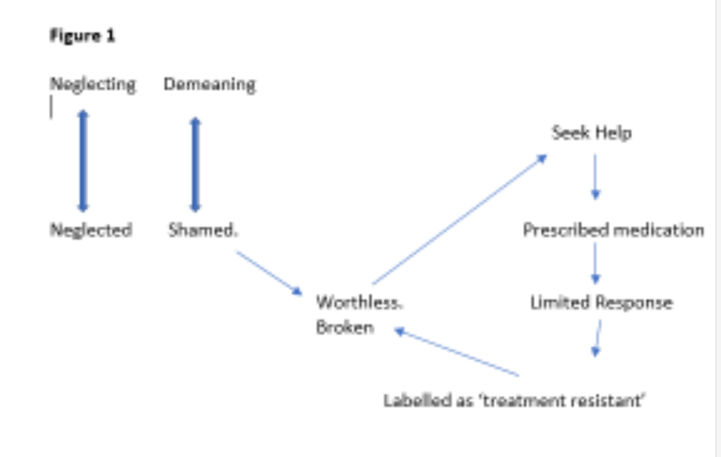
When these idealistic expectations of treatment are inevitably not lived up to, the intensifying feelings of worthlessness and helplessness could lead to a sense of passivity and dependence on medication and services.
“Confronted with the limitations of a mental health service, or any service provision, the need to be ‘fixed’ or cured, can become easily frustrated, because the need may be unmet, as well as unrealistic” (Bell, 2017, page 34).
These expectations might also allow a doctor to protect him or herself from the political reality, perhaps uncomfortable to acknowledge, that there are factors beyond our control. Perhaps the associated sense of hopelessness can be overwhelming or undermining to a doctor’s identity, as somebody trained to ‘make people better,’ as they might fail to live up to an omnipotent ideal. Furthermore, not acknowledging this reality could draw doctors towards increasingly drastic medical solutions which become increasingly punishing or coercive for patients, as I will look at in a case example later in the essay.
In my experience patients tend to have an intuitive sense of what underpins much of their suffering. However, this nuanced and ‘expert’ understanding of their own problems is too often dismissed and reframed in rigid medical language. For example, a patient might talk at length about the nature of their current suffering, and this might be met with a question like ‘so how long have you felt depressed?’ or ‘have you lost interest in activities that you usually enjoy?’ As Thomas Kuhn observed: “The medical model could only reflect psychiatrists’ perception of ‘truth’. Psychiatrists’ understanding of mental disorder had no intrinsic claim to greater legitimacy than their patients’ or anybody else’s.” (Poole and Robinson, 2021, page 35).
The collaborative approach of CAT seeks to find a common language without its own ‘perception of truth, in building an authentic therapeutic relationship, that facilitates access to the deeper knots of one’s mind, which might be voiceless, or held back through shame. A medical approach is likely to fail to access these knots, leaving a superficial or ‘paper self’ (Aves, W. 2024, page 4), that they may not recognise.
Resisting the urge to rescue or punish
Working in acute care, the time to discuss and reflect can be especially limited. In my role working in liaison psychiatry, there have been times when treating people with an EUPD diagnosis when the intention to provide care may be experienced by those receiving treatment as punishment or abuse. Care that may be intended to be ideally caring in response to a crisis but could be experienced as oppressive/punishing/abusive with the impact on the patient being restrained and sedated.
Without the training or experience to understand behaviour in patients with a diagnosis of EUPD, and without an awareness of the powerful emotional pulls their behaviour can exert, it must be overwhelming and bewildering for medical staff to manage these crises. A CAT informed psychiatrist can sit with the patient’s (and staff members) unmanageable distress, attempting to contain it resisting the urge to be pulled into punishing or rescuing roles, understanding that some reflective capacity could potentially be reinstated if this emotional distress were soothed, for both patient and healthcare staff alike.
To admit or not to admit? The dilemma with BPD patients in crisis
I once saw a patient in the middle of the night who was brought to emergency services for excessively self-harming. Fresh in my mind, was the recent Panorama BBC programme about The Edenfield Centre in greater Manchester, which revealed the shocking way that patients were treated by staff. It seemed that a culture had developed in which staff had been drawn toward acting in the top role of punishing, humiliating, victimising reciprocal roles. Without proper oversight, this toxic culture had been allowed to fester.
When being made aware of previous expressed wishes to not be admitted to hospital when in crisis, I sought to model positive reciprocal roles – including listening/respecting to heard/respected. In doing so, it seemed as if I was encouraging them to emerge from the passive powerless role that they were so drawn to when in distress. In these situations, I now consider the roles I might be being drawn into, and try to feel and name unmanageable feelings that may have been evoked in me. Was I being drawn into an ‘ideally caring’ ‘rescuer’ role by refusing to admit them to and saving them from my potentially abusive care? Was I in a ‘punisher’ role by denying them inpatient support, not knowing how to contain their distressing behaviour? The scaffolding of CAT helps to reflect on these forces, allowing me to weigh up my decision in a more nuanced and balanced fashion, something that can be all too difficult in a hospital in the middle of the night.
How Psychiatric care can replicate problematic reciprocal roles from a patient’s past
When psychiatrists are trained to follow a rigid structure which uses medical language, rather than the patient’s own language of distress, within an overwhelmingly biological understanding of mental illness, so much can be lost or, as time goes on – erased as the patient gives up describing distress in their own terms, replacing their own intuitive understanding of their difficulties, with a wholly new narrative, leading to self stigma and alienation. Wren Aves, quoted above, describes her experience of developing a ‘paper-self,’ a self that existed in medical notes, but overtook her ‘real self’ as she tried to meet the needs of staff in order to receive care, fearing that her ‘real self’ would be abandoned, and care would be withdrawn. The care that she received in psychiatric services seemed to reproduce harmful reciprocal roles that she had experienced in childhood, that she did not matter, and that she would have to placate others to receive care, losing herself in the process. I have constructed a partial SDR below to illustrate how the medical care served as a ‘trap’ which intensified unmanageable feelings and caused the patients mental health to deteriorate.
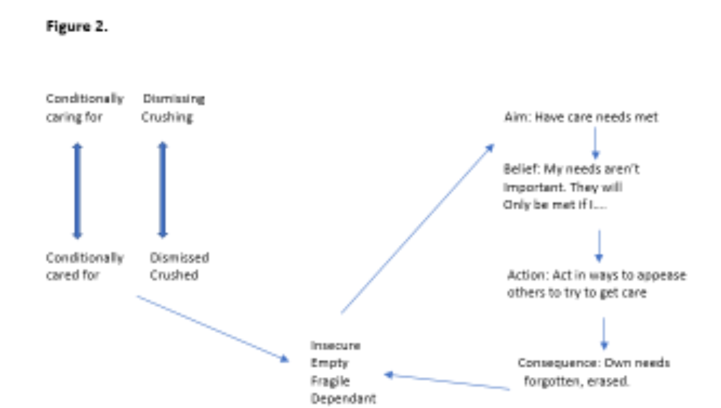
When medical care retriggers established reciprocal role patterns, the patient is again pushed into unmanageable distress, triggering a wide array of responses which may then be used as evidence that the patient still requires treatment, or is ‘getting worse.’
For patients who have experienced abusive care, a response to these unmanageable feelings might be to flip into the top abusing role and become abusive to staff or other patients. In response they are likely be prescribed sedating drugs, which might be given forcibly by injection. This can have particularly troubling echoes for patients who have been victims of physical or sexual abuse in early life. As a CAT informed psychiatrist, I bring this awareness into my practice by ensuring that enforcing medication is an absolute last resort, when all other avenues have been explored (including an attempt at validation and containment of emotional states), and when there is a high risk of harm to the patient or the people around them.
The cost of forgetting, or perhaps avoiding politics
As I have previously alluded to, a conscious or unconscious denial of these political factors and their influence on a sense of mental wellbeing can have a significant impact on patients, as we replace their own interpretations of their struggles with a medicalised view that leaves them alienated and dependant on services. Consequences can also be far reaching at a policy level, as historical mental health reforms show. The Community Mental Health Care (CMHT) model introduced in the 1990s after the process of deinstitutionalisation has not shown significantly improved outcomes (Ikkos et al, 2018, page 2). Patients might be living ‘freely’ in the community, and a medical psychiatric framework of support, but if they are isolated, poor, unemployed, with poor access to services, how can we realistically expect their mental health to improve? Collectively the medicalisation of mental distress protects us from the fundamental unfairness and unjustifiableness of financial inequality, and in doing so punishes and alienates those living in poverty further, fostering a culture of dependence on services and medication.
This downplaying of political factors in mental distress does not just have consequences on the patient. The sense of ultimate responsibility for a person’s safety that this puts upon the psychiatrist can be overwhelming. In ‘8 truths about suicide’ psychiatrist Dr Rachel Gibbons (Gibbons, 2023) talks openly about the devastating impact left by the deaths of patients in her care, describing feeling ‘deeply ashamed, humiliated, and alone.’
“My internal world was shattered and full of dread, and the mental health services I worked within were dominated by the fear of patients, perceived as carriers of ‘risk’ and defended against by risk assessments” (Gibbons, 2023, page 1).
Working under this kind of pressure is bound to evoke unmanageable feelings in consultant psychiatrists, with Target Problem Procedures likely to develop, impacting other staff and patients. In their paper “CAT as a model for the development of leadership skills” Mel Moss and Claire Tanner (Moss and Tanner, 2013) identified two patterns of behaviour in leadership styles of Consultant Psychiatrists that could be seen as a response to these unmanageable feelings. Firstly, they describe an ‘autocratic’ pattern of behaviour, as seen in the Normansfield report, where the team consultant became increasingly controlling and domineering, resulting in a breakdown in relationship with other staff, as they felt the need to either acquiesce or resist the demands of the consultant, whilst the needs of the patients became lost. Secondly, they describe a pattern of ‘disengagement,’ as described in the Staffordshire report, where the role of the consultant in mediating between clinical staff and hospital managers had been lost, leading to a disconnect that contributed to a culture of abusive care (Moss and Tanner 2023, page 13).
In early 2025, I will finish my medical training, and apply for jobs as a consultant psychiatrist, usually taking on a leadership role in the MDT. The self-awareness that I have learned through understanding my own counter-transference and developing my ‘observing eye’ during the CAT course will undoubtedly prove valuable to my leadership skills. It will help me to acknowledge and name unmanageable feelings that might arise in response to patients or difficult team dynamics, and avoid veering into mentioned patterns of autocracy or disengagement occupying the top pole of unhealthy reciprocal roles, instead modelling healthier roles, giving a balanced approach to issues within the team, allowing team members to feel heard and respected.
I have found the process of writing this article valuable exercise in ‘scaffolding’ the concepts I have learnt in CAT onto my role in psychiatry. I have been observing and feeling in the top pole of self-self reciprocal roles. Working in psychiatry I have always carried a complicated array of conflicting feelings, which I have not been able to give voice to at times. By thinking and feeling in a CAT framework, by turning my ‘observing eye’ towards them, I have become a better doctor.
References
Aves, W. (2024) Escaping Iatrogenic Harm, a Journey into mental health care avoidance.
Journal of psychiatric and mental health nursing.
Bell, B. (2017). How CAT-Informed Practice Can Help To Improve Mental Health Services. Reformulation,
Winter, pp.33-37.
Gibbons, R. (2023). 8 truths about suicide. Published online by Cambridge University Press
Gundersman, R (2021). John Keats’ concept of ‘negative capability’ – or sitting in uncertainty is needed now more than ever. Available at: https://theconversation.com/john-keats-concept-of-negative-capability-or-sitting-in-uncertainty-is-needed-now-more-than-ever-153617/ (Accessed 28/02/2024).
Ikkos, G et al. (2018). From Community to Meta-Community Mental Health Care. International Journal of Environmental Research and Public Health.
Moncrieff, J. (2014). The chemical imbalance theory of depression. Still promoted, but still unfounded. Available at: https://joannamoncrieff.com/2014/05/01/the-chemical-imbalance-theory-of-depression-still-promoted-but-still-unfounded/ (Accessed 28/02/2024).
Moss,M and Tanner, C. (2013). CAT as a model for development of leadership skills. Reformulation, Winter, p.11,12,13,14.
Poole R, and Robinson C, Mind, State and Society. History of Psychiatry and Mental Health in Britain 1960–2010. Chapter 4 page 35. Cambridge University Press, 2021.