


Krystina Jacobs & Malinder Bhullar, 2025. Towards a more inclusive CAT: Integrating an updated Psychosocial Checklist with the Psychotherapy File Reformulation, Spring
Introduction
Mental health difficulties can be pathologised in therapy. Aims and outcomes may become focused on ‘fixing’ or eliminating, rather than understanding or integrating into an understanding of self and relational patterns that arise from adverse experience, including persistent systemic failure to recognise and be inclusive of diversity. Our early relational blueprints are formed against a backdrop of unequal societies, and social messages shape our internal dialogue (Lloyd & Pollard, 2018). CAT emphasises the social and cultural formation of the self, and suggests that personality is maintained through relating, cultural influences, and social realities for the individual concerned.
ACAT’s Anti-Racist Statement (October 2021) highlighted the need to face a key social reality, that racism exists, including within ACAT. However unconscious or uncomfortable, it is critical that we do not shy away from conversations with our clients, supervisees, supervisors and each other about the harmful social and relational impact of racism, privilege and power. Subsequently we advocate for the CAT community to shift, with courage and without apology, towards a felt sense of relational safety. For example, as illustrated in the reciprocal roles below:
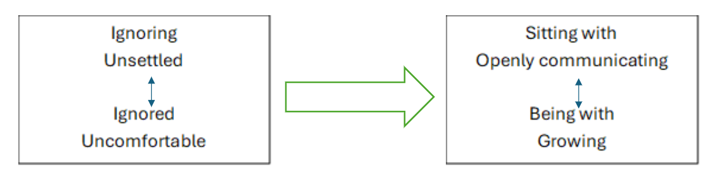
By embracing the above, CAT is invited to modernise as a relational trauma/adversity-informed model premised on it being a ‘whole-person whole-context’ approach. We posit that internalisation of reciprocal roles is not simply a child copying their relationship with caregivers, siblings and peers but a rich, complex and dynamic process that involves aspects of diversity such as gender, sexuality, socioeconomic class, religion, race and now, from living in an age of rapidly advancing technological and social media immersion. Unless we balance the narrative focus of personal experience with these social factors and forces in ‘real world’ terms, we only have partial formulations (Lloyd & Pollard, 2018) and subsequently, only partial solutions.
In short, understanding, seeing and working with diversity and inclusivity has never been more critical. This being said, we appreciate that the “how” and “with what” remains a challenge for therapists, arguably more so for those who may feel apprehensive and/or inadequately equipped to work in diversity-affirming ways. It is essential for CAT therapists, of any background, to have access to tools and techniques that: a) acknowledge societally and culturally driven patterns, and the economic and social realities that have shaped personal narratives; b) compassionately see and work with reciprocal role procedures that individuals have relied on to survive adverse social circumstances and c) are practical, accessible and inclusive, in and of themselves. It is furthermore essential that tools and techniques take into consideration the needs and characteristics of both clients and therapists, in keeping with CAT’s fundamental relational principles, including working constructively with the ZPD.
Reviewing and updating the Psychosocial Checklist
The Psychosocial Checklist is a psychological tool developed in 2004 as an outcome of a workshop offered by then-CAT North (now Catalyse). It was designed to explore the impact of an individual’s social and cultural context upon wellbeing. We believe the Psychosocial Checklist is a helpful, user-friendly and readily available tool to offer alongside the Psychotherapy File during the assessment phase of CAT. However, while the Psychotherapy File was updated in 2022, the Psychosocial Checklist has not been updated since 2006 (Pollard & Toye, 2006).
Given our position advocating for an explicitly Anti-Racist and overall more inclusive CAT, we support the offering of a ‘GRACEful CAT’, in alignment with other psychological models which are integrating the diversity and difference acronym of Social GRACES (Burnham, 2012). Social GRACES is a mnemonic explaining the visible and invisible aspects of our identity. It makes aspects of diversity explicit and therefore, at least in theory, easier to bring into therapy, supervision and personal reflection spaces. The GRACES are:
G: Gender, Gender Identity, Geography, Generation
R: Race, Religion
A: Age, Ability, Appearance
C: Class, Culture, Caste
E: Education, Ethnicity, Economics
S: Spirituality, Sexuality, Sexual Orientation
As CAT-trained neurodivergent psychologists of colour, reviewing the Psychosocial Checklist has been personally meaningful. We were especially interested in updating the language and moving away from a ‘checklist culture’ towards a dialogic, narrative-driven and ultimately CAT-aligned one. While efficient and accessible in its own right, ‘checklist culture’ presents a critical disadvantage where for example, ‘tick-boxing’ completion of equality and diversity training confers competence, inviting complacency, and is counter to a dialogic approach.
We both offer the Psychosocial Checklist during the assessment phase of CAT with respectful curiosity. We learned that it consistently invites an open, organic unfolding and meaningful conversation, which may not arise spontaneously during history-taking. It communicates our commitment to valuing and inviting the ‘whole person’ into the therapy space and can create space for authentic self-disclosure, as guided by the ZPD of therapist and client. Such dialogue allows for objective yet meaningful reflection on power and privilege within the therapy, thereby facilitating a psychologically safe and containing space for aspects of diversity to be noticed and named; and subsequently reflected upon within supervision. This potentially addresses any arising discomfort as shown in the reciprocal roles above, especially if and/or when unconscious or overlooked aspects abruptly emerge into awareness mid-therapy or nearing the ending.
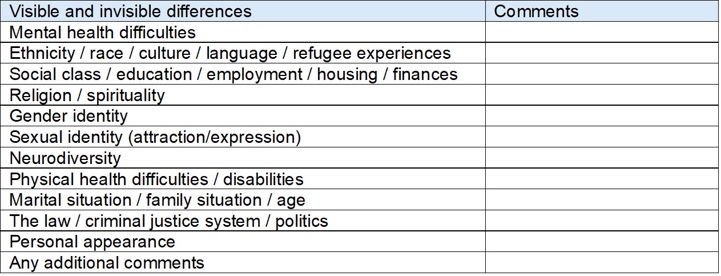
Figure 1 below shows the existing version of the ‘Psychosocial Checklist’ while Figure 2 shows our suggested update, provisionally titled ‘Part 5: Diversity and Difference’. To be inclusive, we suggest this tool is integrated into the Psychotherapy File following Part 4 ‘Difficult and Unstable States of Mind’, rather than administered as a standalone option. This procedural shift, especially at the outset, communicates the equal importance of diversity conversations alongside routine identification of patterns and procedures.
Figure 1: Psychosocial Checklist
The social and political circumstances of our lives can have as much if not more influence on how we feel as our own individual histories and experiences. It can sometimes help us make sense of how we feel if we recognise. Please tick the boxes that you feel apply to you. Aspects of myself or my life I feel unhappy about, disadvantaged by or in which I feel ‘different’ from other people:
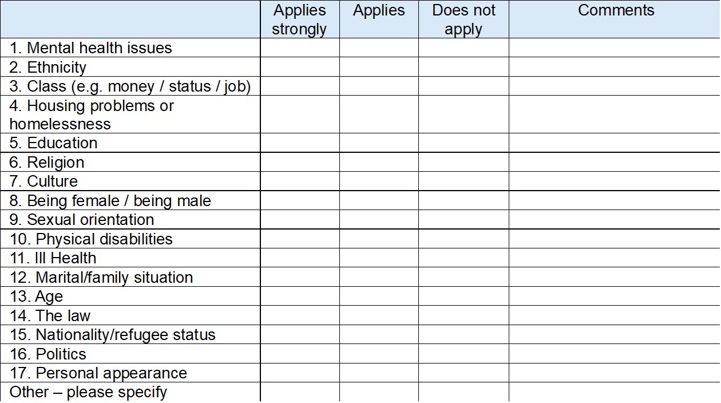
Figure 2: Psychotherapy File - Part 5 - Diversity and Difference
CAT offers a whole-person inclusive approach, recognising that society influences and shapes the patterns we choose on the psychotherapy file. This page is an invitation to make a few notes and comments beside any aspects of personal identity which feel meaningful for you, to guide our conversations on the psychotherapy file, and which we may bring into future CAT conversations during your therapy if it feels safe, helpful and therapeutic.
Anecdotal evidence from our practice to date has shaped our position in this paper that the ‘Diversity and Difference’ tool holds significant promise. Clients have presented as visibly moved when invited to bring into dialogue important aspects of themselves, that they were perhaps not expecting to be invited to share, or in some cases, unconsciously expecting to be disregarded or even punished for. We have also taken into consideration feedback from a cohort of current CAT trainees, and two clinical psychology doctorate courses receiving teaching on an ‘Introduction to CAT’, who especially appreciated the incorporation of the tool within the Psychotherapy File.
Concluding reflections
Our hope with the ‘Diversity and Difference’ psychological tool, represented by its explicit integration of the Social GRACES and embedded within the Psychotherapy File, is that it practically facilitates the enhancement of CAT as a more inclusive, diversity-affirming therapeutic approach for both clients and therapists. We hope it will be consistently offered alongside the Psychotherapy File, to then be integrated formally as ‘Part 5’ into the next updated Psychotherapy File.
We propose that the ‘Diversity and Difference’ tool, and its underpinning theoretical framework, becomes a standard feature of training in CAT, as part of a trainee’s appraisal, supporting working effectively with diversity, difference, power and privilege as a CAT specific competency, beyond generic competency, as defined by the CAT Competency Framework (Parry, Bennett, Roth & Kellett, 2021).
As proposed by Potter (2020), we hope the ‘Diversity and Difference’ tool will support contextual awareness as an unintended fruit of CAT, earlier in therapy, to be able to hover, shimmer, and participate, with balance as we navigate within us, between us, and around us. We also hope it may be considered to enhance the CCAT sessional rating scale (Bennett & Parry, 2004).
Additionally, we acknowledge other diversity-affirming tools and practices that could complement the ‘Diversity and Difference’ tool or indeed be weaved into CAT at any stage deemed helpful. These include: visually sharing Wheels of Power and Privilege (for example, Roberts et al., 2019); or “The Genderbread Person” edugraphic (Killerman, 2017) as an in-road to conversations about gender identity.
We anticipate a need to develop and provide professional development spaces where we can learn to feel confident sharing and using the ‘Diversity and Difference’ tool in a meaningful way. Finally, we are aware of imagining that moving towards practicing meaningful inclusivity in our CAT community, might feel like an invitation to redirect a moving battle tank at short notice. We appreciate the potential for apprehensiveness, or even resistance. We welcome such responses as opportunities to engage in dialogue and to expand our horizons. As the saying goes, “great things never came from comfort zones”.
Authors
Krystina Jacobs, Clinical Psychologist for NHS Trust HPFT, CAT psychotherapist in private practice, and visiting lecturer with Hertfordshire University.
Malinder Bhullar, HCPC Practitioner Psychologist; Head of Psychology at Spring Wood Lodge - Complex Inpatient Rehabilitation and PICU Service for Women (Elysium Healthcare); Consultant Psychologist in private practice.
References
Bennett, D., & Parry, G. (2004). A measure of psychotherapeutic competence derived from cognitive analytic therapy. Psychotherapy Research, 14, 176-192.
Burnham, J. (2012). Developments in Social GRRRAAACCEEESSS: visible – invisible and voiced – unvoiced. In I.B. Krause (ed.), Culture and Reflexivity in Systemic Psychotherapy: Mutual Perspectives (pp. 139-160). London: Karnac.
Killerman, S. (2017). A Guide to Gender: The Social Justice Advocate’s Handbook. Impetus Books: Austin TX.
Lloyd, J., & Pollard, R. (2018). Cognitive analytic therapy and the politics of mental health. Routledge: London.
Parry, G., Bennet, D., Roth, A.D., & Kellet, S. (2021). Developing a competence framework for cognitive analytic therapy. Psychology and Psychotherapy: Theory, Research and Practice, 94 (s1), 151-70.
Pollard, R. and Toye, J., 2006. Updating the Psycho-Social Checklist. Reformulation, Winter, pp.19-21.
Potter, S. (2020). Therapy with a Map: A Cognitive Analytic Approach to Helping Relationships. Pavillion: Brighton.
Roberts, J.D., Mandic, S., Fryer, C.S, Brachman, M.L., & Ray, R. (2019). Between Privilege and Oppression: An Intersectional Analysis of Active Transportation Experiences Among Washington D.C. Area Youth. Int. J. Environ. Res. Public Health, 16, 8.