


Recent posts
Krystina Jacobs, Aoife Martin, Pamela Jameson, Elizabeth Haycock, Wendy Mather, Katherine Ford, 2025. Experiences of Online CAT Reformulation, Spring
Abstract
A small-scale research project was conducted by IRRAPT (Inter-Regional Residential ACAT Psychotherapy Training) trainees to explore, with their cohort of trainees, experiences of offering and receiving online CAT. The project focused on helpful and unhelpful aspects of online CAT, as well as inviting reflections on the therapeutic relationship, CAT tools, enactments and endings.
Introduction
During their 2021 to 2023 IRRAPT training journey towards becoming a cognitive analytic psychotherapist, a small-scale research project was conducted by a group of six trainees. The aim was to explore with their cohort, experiences of online CAT, which has been increasingly offered during and following the 2020 global pandemic, with particular curiosity as to whether technology invites reciprocal roles of ‘safe distantly disembodied-uninvolved disconnected’, and whether a relationship with technology such as ‘valuing/trusting/accessible-valued/trusted/competent’ enables a therapist to feel comfortable and familiar with digital platforms, to offer a ‘good-enough’ online CAT, especially if the therapist is comfortable with the software to translate the CAT model and tools online, including flexibly sharing screens.
It has been suggested that virtual therapy raises the question of the importance of a physical setting, necessary for emotional containment, including the loss of the sensory features of a room which communicates warmth and care (Lemma, 2017). And whether the virtual waiting room, is the virtual equivalent of opening a therapy door, noticing especially the absence of lighter conversation which occurs from corridor to therapy room, ‘warming the context’ in preparation for the session to begin (plus the abruptness of clicking a button to end a therapy session). It has been suggested that there is a noticeable loss of the therapist and client presence during virtual therapy, the sensation of being there, a sensorially deprived exchange, no longer ‘bodies together now just minds’ together, due to the loss of non-verbal and unconscious communication including somatic countertransference. And it is possible that the non-verbally expressed internal world of the client is not fully explored and the unconscious made visible, especially what the body would have communicated in the silences (Lemma, 2017).
It has been acknowledged that delays and distortions with the technology during online therapy can become confusing and disruptive (contributing to the loss of body language, gaze, facial expression and movement), and the frequent mismatch and misunderstanding can elicit negative emotion, impacting upon building up a trusting therapeutic relationship. And as social media encourages a friendly casualness, this can communicate the message that online therapy is more informal with relaxed boundaries and inviting enactments (Lemma, 2017). Additionally, online therapy can invite the online disinhibition effect (Suler, 2004), where the client might behave differently online compared to in-person, including sharing their thoughts or feelings more quickly, feeling loosened up to act out desires as it does not feel as real (feeling instead like there is less authority judging).
Methodology
The six researchers designed and circulated an anonymous questionnaire of open-ended questions amongst the current IRRAPT cohort of 15 trainees. Questionnaires were completed by all trainees (including the six researchers) with questions focusing on the helpful and unhelpful aspects of online CAT, as well as inviting reflections on the therapeutic relationship, CAT tools, enactments and endings. The questionnaires were analysed using the principles of Framework Analysis (Ritchie et al., 2003), a type of thematic analysis, which is a systematic and flexible approach to analysing qualitative data. Themes are generated to describe the data – involving charting & developing a framework matrix (creating a structure for the data).
Results
Overall, the number of clients seen for online CAT by the 15 IRRAPT trainees, 6 trainees had seen 1-5 clients, 3 trainees 6-10 clients, 3 trainees 11-20 clients, and 3 trainees had seen 20+ clients. And in comparison, to in-person CAT, the experience of facilitating online CAT was described as better by 1 trainee, worse by 8 trainees, and indifferent/same by 6 trainees. The qualitative comments provided to describe offering online CAT were summarised as ‘it is a valuable and useful option, especially to increase accessibility for clients, but in-person offers a higher quality relational experience’.
Concerning online CAT as personal therapy, 11 of 15 IRRAPT trainees had experienced this, and in comparison to in-person CAT, 3 trainees indicated it was better, 4 trainees indicated it was worse, and 4 trainees described it as indifferent/same. And the qualitative comments concerning CAT as personal therapy were summarised as ‘it is valuable, worthwhile, I feel grateful for the accessibility, choice, and time-efficiency, but technology can impact, and it isn’t for everyone’.
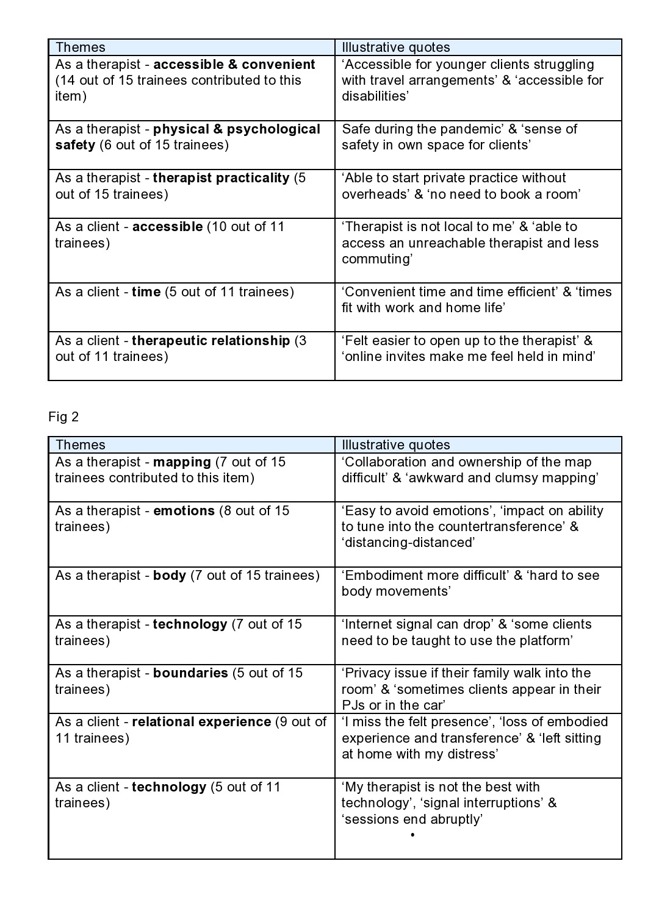
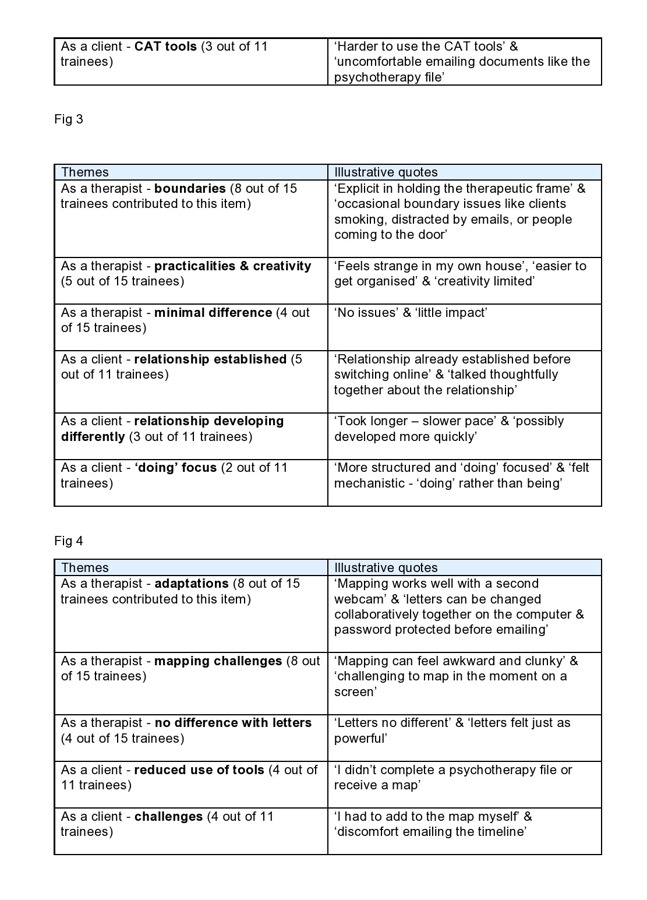
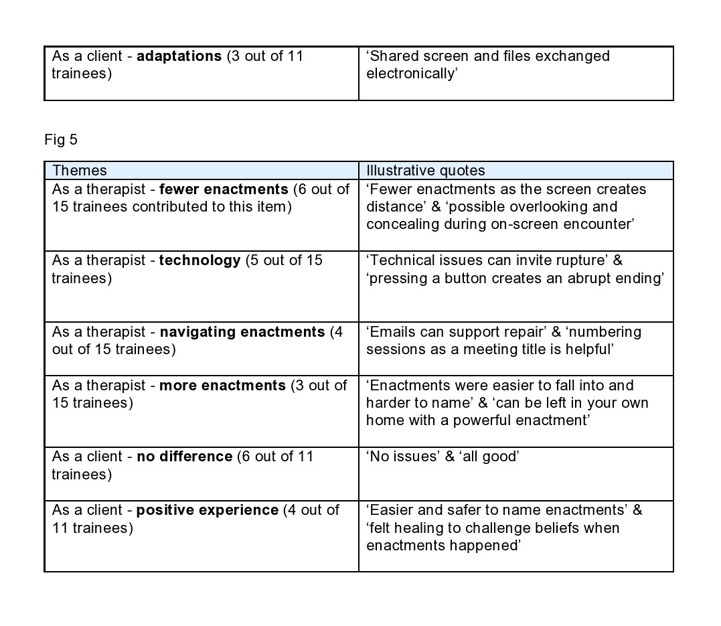
The themes of the five key questions, with illustrative quotes, from the questionnaires are summarised in the below five tables.
Conclusion
The key findings included that trainees identified, following reflection on offering virtual therapy to clients and receiving online personal therapy, the main benefit was the accessibility and practicality, although trainees were aware that adaptations to CAT were essential. Trainees identified that the therapeutic relationship could be established and maintained during virtual CAT, although there was awareness of the impact on boundaries, creativity, and accessing emotional and bodily communication. It was also identified that they key challenges with online CAT is the issues with the technology and adjusting practice with the CAT tools.
Overall, the researchers did find using a thematic methodology useful for this project as it is an exploratory structured approach, although the limitations include it relies on some retrospective recall, which introduces bias into the data. Also, methodological limitations include the small sample, which raises questions on whether the perspectives are representative of other CAT therapists across the UK and globally, and the generalisability of the study findings. Further research could involve replicating the study with a larger sample, and capturing client perspectives of online CAT.
To conclude, the findings of this small-scale study offers insights and considerations to support CAT therapists and psychotherapists offering online therapy. The clinical implications include that the study offers an encouraging message of possible ways of enhancing current online practice, including supporting newly accredited CAT therapists as they explore and move towards becoming an experienced autonomous therapist who experiments with creativity within the CAT framework, as they develop their own professional identity. Lastly, it is hoped that the findings from this current study may invite discussion and dialogue to support learning and development on CAT training courses and support reflective conversations in CAT supervision for therapists and psychotherapists.
References
Lemma, A. (2017). The digital age on the couch: Psychoanalytic practice and new media. Routledge: New York.
Ritchie, J., Lewis, J., Nicholls, C.M., & Ormston, R. (2003). Qualitative research practice. London: Sage.
Suler, J. (2004). The online disinhibition effect. Cyberpsychology & behavior, 7, 321-326.