


Use Heading 2 for Copied & Pasted Details (top of article from old site - this to include the author name, etc as it appears in old site.) Example:
Cathy Harding, 2025. A CAT understanding of challenging behaviour in Learning Disability work. Reformulation, Spring.
Introduction
Although person-centred care has allowed advancements in empowerment for people with learning disabilities (LD) it is also essential that we position relational care central to the provision of care. This article argues that challenging behaviour can be understood as a relational process. As ever in CAT this is written to encourage increased dialogue, and allow thoughts to be shared, it will not alone provide all the solutions. By doing this, exits from target problem procedures can be helpfully shared with care staff to promote healthier relationships and provide emotionally aware care.
This article will not aim to add to the already extensive debate about the offering of individual psychotherapy to individuals with LD, as I do not think this needs further debate. I align myself with Beail’s clear stance that “people with mental retardation have a right to a similar range of therapies that are used in the general population” (Beail, 2005, p 443) and to Skelly’s (2022) idea that offering therapy too early risks placing the responsibility for trauma back on the individual, and in a CAT framework this risks reinforcing unhelpful reciprocal roles.
Understanding behaviours that challenge as relational and in dialogue
Behaviours that challenge are widely agreed to be behaviours of such severity, intensity and frequency that they place the person or others at risk of harm and/or of exclusion from community facilities; and are outside the cultural norms for that individual (Emerson, 2001). Positive Behavioural Support (PBS) is widely used within LD services and particularly in relation to individuals who present with behaviours that challenge.
The behavioural theories underpinning the understanding of behaviours that challenge in PBS, may seem at odds with the relational elements of CAT; and risk the reduction of people to behavioural data that results in objectification (Quinn, in press). Yet one of the 5 principles for PBS is relationships. In addition, behavioural support plans are delivered within a relationship by carers or family members and the relational framework offered by CAT can support both these areas.
Central to PBS is developing an understanding of the functions of these behaviours within the person’s context, and that all behaviour has meaning (Pitonyak, 2005). Herbert Lovett in his book ‘Learning to Listen’ introduces the idea of a more relational and dialogical understanding of challenging behaviour (Lovett, 1996). He notes that “service systems…almost invariably imitate the people they attempt to serve. People who are dangerously aggressive tend to attract services that act out violently”. (Lovett, 1996, p228). This can be seen the idea of reciprocal roles echoing through the system and the system risking enacting these roles. In thinking relationally about challenging behaviour we can allow attributions, beliefs and attitudes toward the person to become an important part of this assessment (Varela, 2014).
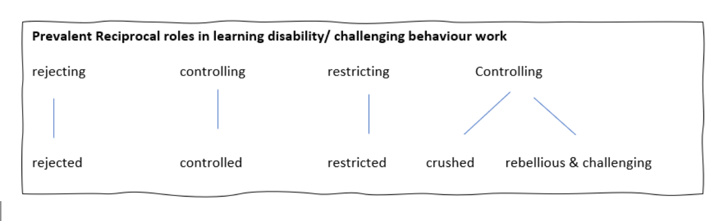
It is thought that individuals with learning disabilities have a more limited number of reciprocal roles (RR) due to the limited relational experiences that people with LD may have. This coupled with the impact trauma can also have on limiting the repertoire of RR, and that trauma is more commonly experienced in people with LD (see Fletcher, 2016, BPS, 2017). In addition, it has been proposed that individuals could become stuck in an infantilised role, further adding to their range of RR being limited (see King, 2005). Those RRs most common within LD have been explored, including idealised and feared roles (see Psaila and Crowley, 2006. Greenhill (2011) in her article links the roles of rejecting to rejected and controlling to controlled specifically to behaviours that challenge. Furthermore, the controlling to controlled role often spoken about within challenging behaviour and was elaborated upon to describe a pair of related RRs, either controlling to crushed, or to rebellious and challenging (Fisher and Harding, 2009).
Techniques often used by staff can be non-reflective and risk increasing the likelihood of behaviours continuing in the long term (even if they stop the incident in the moment; Hastings & Reminton, 1994). CAT can help with any unmanageable or unspeakable feelings because this allows staff to feel understood and extend this understanding to their clients; incorporating the ideas of good enough care (Lloyd and Williams, 2003). The idea of ensuring staff respond to the person as opposed to simply their behaviour has been incorporated into key guidance (e.g., RCP, BPS & RCSLT 2007). We know that carers’ thoughts, emotions and behaviours are intrinsically linked to the care that they provide and how this maintains the very behaviour they may be aiming to alter (Verela, 2014). The controlling to controlled or rebellious role seems particularly pertinent to hold in mind when thinking about intervention strategies within a PBS framework, especially as this can include restrictive interventions.
In CAT, we know that helping people to be aware of these RR and actively encouraging reflection, acknowledgment and alternatives to these can aid them to step outside of these roles and offer an alternative relational experience. That the relational understanding and mapping of this, in itself can be an exit. There is a reasoning that aggressive behaviours may be a way of maintaining a Reciprocal Role Procedure (RPP) and so awareness of what underlies this aggression allows the possibility of different actions to occur.
Behaviours that challenge, as in dialogue with the system
Alongside these individual RRs and RRPs, there are wider considerations. The dominant understanding of learning disability within services relies heavily on the concept of intelligence, usually framed very narrowly as cognitive intelligence and heavily influenced by Piaget. This is an un-CAT like way of understanding. By allowing a Bakhtin influenced understanding of learning, in which it exists in a dialogue between two people, which becomes internalised, we can allow people with a learning disability to move to a more empowered position. It allows intelligence to be placed within a relational space (rather than as a standalone element within people’s minds). Allowing the increasingly influential work of attachment theory to be balanced alongside intelligence and considered in relation to an individual (or their staff team). Thinking about this in the context of people with LD, whose existence may be reflected back “tinged with contempt, disappointment, distance or not at all” (Greenhill, 2011 p 14), it is not surprising that such a relational frame could get a response in the form of behaviours that challenge. If we treat people as if they are contemptible and disappointing, they may react by becoming more disillusioned and ‘difficult to manage’. This dialogical understanding of learning also engenders a hopefulness that in relation with another, support can aid people to behave differently. If support is offered within the person’s Zone of Proximal Development (ZPD) then they can have different interactions and therefore behaviours that are challenging can be altered.
In addition, the ‘out of sight out of mind’ position that people with learning disabilities still often find themselves in impacts on views of the self in society. Out of county placements can become the norm, especially for those with significant behaviours that challenge and there may be a potential to focus on the service provider rather than service user (King, 2005). There is the possible grief at the loss of the normal self for the individual and their family (Flethcer, 2016) and the frequent changes of terminology used to label LD, as if that will make the disability more palatable (Sinason, 1992). All of these can be seen as indicators of society’s interaction with disability and a social exclusion of this population, coupled with the fear and actuality of eradication for this group. This interpersonal and intrapersonal distress can add to the person with LD’s lack of interaction and can impact on CAT therapist’s dialogical engagement with people with learning disability.
Antecedent behaviour and consequences, through a CAT lens
Within a behavioural framework there is emphasis on the antecedents and consequences of behaviours. There is work on the importance of internal triggers (Harding, 2021) which can be thought of as the activation of RR or procedures. In the work of Bancroft et al (2008) they describe behavioural ideas within a CAT paradigm. They state that reciprocal roles have an approximation to the behavioural concepts of “mutual stimulus and response”. Crucially, they also state that “whereas in behavioural terms we refer to ABCs (Antecedent, Behaviour and Consequence), in CAT we find a similar account in one of the procedural sequences described as a trap” (p.23). This is summarised by Moss (2007) “the triggers and consequences of challenging behaviour can…be conceptualised as reciprocal role procedures between the client and their support system, namely around issues of control and punishment”.
In addition, behavioural models state the challenging behaviours are reinforced (positively or negatively) by the consequences they bring the individual. It would be overly simplistic if this did not take into account relational elements within the concept of consequences. So, enabling PBS plans to encompass the reciprocal roles and procedures allows the possibility of a different response (or consequence) to be given. In reference to the ideas above, if we can help staff to reflect upon their work, we can allow them to open up discussion about how they could be unwittingly colluding with RRPs (Bancroft 2008).
RRP would also occur in self to self-relationships, however this is explicitly discussed less within the learning disability CAT literature. Yet, it is important, particularly when working with individuals who may have self-harming or self-sabotaging behaviours to include these ideas; that what we have done with another today we will do on our own tomorrow, and this may include dismissing (of our own needs) and abusive behaviours to self. For some people extremes of self harming/abusing behaviour can feel powerful or soothing in the short term. The level of risks can also lead to increases in secure provision and/or staffing levels, this controlling to controlled RR can mask as the ‘idealised place’ of perfect care, but actually this is often overly controlling and restrictive and leads to RR of abused to abusing or annihilating to annihilated over time (see Quinn, in press).
Developing a shared formulation
The sharing and co-creating of formulation has become increasingly common in PBS practice. Simply sharing this formulation has been shown to improve behaviours that challenge (Ingram, 2011), and this relational conceptualising can in itself provide an exit. CAT supports the understanding of relational experiences, and the RR presented within the SDR helps individual and staff teams to think about exits and how relational behaviour can be modified. The use of SDRs to facilitate change and improve staff morale has been described in working with BPD (Ryle 1997), CMHT’s (Dunn & Parry 1997), PICU’s (Kerr 2001) and within LD services (Lloyd and Williams, 2003). The aim is for something which is collaboratively achieved and emphasises the reciprocal nature of procedures, shows each RR is part of the self and the other and demonstrates how RRP may manifest (Ryle and Kerr, 2002). I completely concur with Greenhill (2011, p 10) when she says that “working within a CAT framework has helped give me a framework for my practice so that the person can be more relationally understood and empowered within their systems”. I have found it easy to translate staff experiences into RR and RRP; in a way which is non-blaming and this reflects many of the strengths of SDR in staff teams as described by Moss (2007).
Staff teams can be helped to move towards an ok/healthier position in relation to the individual (Elford and Ball, 2014). Within a CAT SDR there is a way of acknowledging the idealised position which, in LD services, often includes a rescuing and caring to rescued and cared for, or special and perfect to learning disabled role (Psailia and Crowley 2006). The resulting striving procedure, can lead staff teams to become stuck in the dreaded place reinforcing patterns of neglect or control.
We need to allow the collaborative stance of CAT to enable us to help carers reflect on RRs and RRPs and how we might all unwittingly reinforce these in trying to cope with situations in the best way that we can (Bancroft, 2008). Whitby (2008) warns us that failing to acknowledge how distressing it is to witness other people’s distress makes it hard to provide the empathic care we may strive for and instead can lead to situations where abusive practice flourishes.
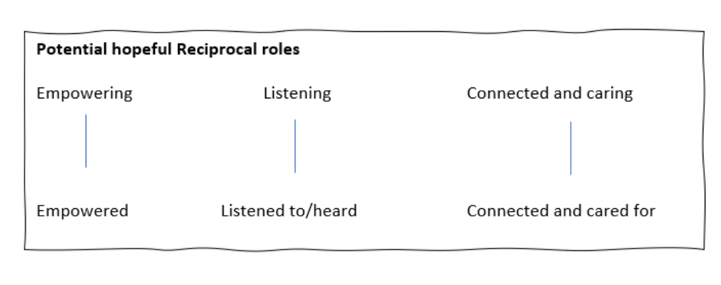
Embodied within this collaborative stance is a chance to think about the SDR and whether this is shared with staff teams or developed with them. Of course it needs to be an individual’s choice whether an SDR developed in therapy is shared with those who support the person. The client who chose to put “her SDR on the fridge in her residential home for all to see” (Bancroft, 2008 p.23) is an example of ownership of the SDR and an example of a positive RR of empowering/empowered. This role is so often lacking in the lives of people with LD; although the healthy adaptation of the rebel role is of itself empowering. By working alongside clients explicitly in a CAT framework, it is possible to begin to address the stark power imbalances that are often prevalent in the lived experience of people with LD, within their care provision and society more generally (as mentioned above). This power imbalance could be further added to by the PBS process and having a PBS plan written about you. The embracing of the CAT SDR and exits may allow the person to be held more centrally and therefore powerfully within their own plan. The idea of RR is also accessible to staff teams and my experiences of introducing RR into staff discussions is powerful.
Hopeful RRPs
I believe the idea of a hopeful SDR (Bradley, 2012) which includes positive RRs that the individual may have experienced or may demonstrate to others is useful, and could be utilised further in understanding behaviours that are challenging. These roles offer the chance to acknowledge strengths and hopes for the person. In mapping the positive RR and explicitly tracking this using the ideas of BAPAF (belief, aim, plan, action, feedback) they can then become exits to the Target Problem Procedures (TPPs) (Bradley, 2012). This links directly to the idea of our RR emerging in dialogue with another, in that if individuals have no experiences of these positive relational interactions, then positive care skills may not develop (Potter, 2020). It can be hard to be kind and tender to yourself if no-one has been kind or tender to you (Potter, 2020); and perhaps this is even starker in a society where this kindness may not be reflected back to you on a wider scale. These hopeful RRs allow an explicit naming of these untried skills and more helpful RRs and allows them to be explicitly scaffolded into staff’s development and carers aims, within their zone of proximal development. In naming these with staff we increase the chance for them to know what we want them to do, and therefore allows us to include a hopeful place allowing a more functional part of themselves to be included and integrating strengths (Bradley et al, 2016). This allows a challenging of societal narratives, looking for the ability rather than the disability and helping embrace individual strengths and capacity to be caring, valued and listened to.
Conclusion
In conclusion, once we begin conceptualising behaviours that challenge in a relational framework there is an opportunity to address power imbalances and allow an understanding of the relationships that exist between staff and people with learning disabilities to be a part of our interventions. As the current prevalent model within LD services is that of PBS then this framework needs to be used alongside CAT formulation to allow primary, secondary and reactive interventions to be thought about relationally and to include the positive RRs we are trying to support individuals to develop. The overlap between the ABC model of behaviour and the ideas of traps, snags and dilemmas has been outlined. PBS plans are delivered in an interaction, between the individual with a learning disability and their carers. The more we place this relationship central to PBS plans then the greater the chance of helping people to respond within relationships in a way which helps embed the positive changes desired and allows a greater chance of empowerment for people. This approach will also support changes in the behaviours that challenge, the behaviours which may prevent individuals developing relationships within their wider communities and which maintain the cycle of limited relational experiences and therefore limited RRs.
Acknowledgements
I would like to thank the people with LD and their staff teams I have worked with and developed these ideas alongside. Also, to the teaching team at the South Wales CAT course, for their bolstering support of me and of their willingness to be inclusive of LD work and thinking.
References
Allan, D. 2009. Positive behavioural support as a service system for people with challenging behaviours. Psychiatry, 8, 10. 408-421.
Bancroft, A. Collins, S., Crowley, V., Harding, C., Kim, Y., Lloyd J. and Murphy, N. Is CAT an Island or Solar System? The dilemmas in the therapeutic frame when working with people in learning disabilities services. Reformulation, 30, 23 - 25.
Beail, N. (2005) Responses to Sturmey (2005) on psychotherapy: Evidence base for behavioural interventions: Critical commentary. Mental Retardation, December, vol. 43/6, 442-445.
BILD, 2017. NHS Health Education England, Skills for Care, Challenging Behaviour Foundation, PBS Academy. 2017. Key messages about positive behavioural support. http://pbsacademy.org.uk/wp-content/uploads/2017/05/PBS-key-messages-April-2017-1.pdf Accessed 10th October 2020
BPS, 2017. Incorporating Attachment Theory into Practice: Clinical Practice Guideline for Clinical Psychologists working with People who have Intellectual Disabilities. BPS Leicester.
Bradley, J., 2012. A Hopeful Sequential Diagrammatic Reformulation. Reformulation, Summer, pp.13-15.
Bradley, J., Cox, P. and Scott, J. 2016. A Hopeful Sequential Diagrammatic Reformulation – Four Years On. Reformulation, Summer, pp.30-39
Dunn, M & Parry, G. 1997. Formulated Care Plan Approach to caring for people with borderline Personality Disorder in a Community mental health service setting. Clinical Psychology Forum, 104. 19-33.
Emerson, E . 2001, 2nd edition. Challenging Behaviour: Analysis and intervention in people with learning disabilities. Cambridge University Press
Elford, H. and Ball, Z. 2014. Using Cognitive analytic therapy in a systemic context with staff Teams: Reflections of the process of facilitating an intervention. In . J. Lloyd and P Clayton (Eds) Cognitive Analytic Therapy for people with Intellectual Disabilities and their carers. Jessicia Kingsley publishers.
Fletcher, H. (2016). Attachment relationships between parents and their children: The impact of the loss of the healthy child. In H. Fletcher, A. Flood, & D. J. Hare (Eds.)
Fisher, C., & Harding, C. (2009). Thoughts on the rebel role: Its application to challenging behaviour in learning disability settings. Reformulation.
Greenhill, B., 2011. "They have behaviour, we have relationships?". Reformulation, Winter, pp.10-15.
Harding, C. 2021. Using PBS to provide emotionally aware care In N. Beail, P Frankish and A Skelly (eds) Trauma and Intellectual Disability; acknowledgement, identification and intervention. Pavilion
Hastings R., & Remington, B. 1994. Staff behaviours and its implications for people with learning disabilities and challenging behaviours. British Journal of Clinical Psychology. 33 (4) 423-438.
Ingram, B. 2011. Collaborative psychosocial case formulation development workshops: a case study with direct care staff. Advances in mental health and intellectual disabilities, 5, 2 p. 9-15.
Kerr, I. 2001. Brief cognitive analytic therapy for post acute manic psychosis on a psychiatric intensive care unit. Clinical psychology and psychotherapy, 8, 117-129.
King, R. 2005. CAT, the therapeutic relationship and working with people with learning disability. Reformulation. Spring p.10-14.
Lake, N. 2008. Developing skills in consultation 2: A team Formulation approach. Clinical psychology Forum, 186- June p. 103-113.
Lovett, H. 1996. Learning to listen. Positive approaches and people with difficult behaviours, London Kingsley.
Lloyd, J. and Williams, B. (2003). Reciprocal Roles and the 'Unspeakable Known': Exploring CAT within Services for People with Learning Disabilities. Reformulation 19. 19-25
Mencap, 2016. Bullying wrecks lives: the experiences of children and young people with a learning disability. untitled (mencap.org.uk) accessed June 2021.
Moss, A. 2007. The application of CAT to working with people with learning disabilities. Reformulation. Summer p. 20-27.
Oakes, P. (2012). Crash: What went wrong at Winterbourne View? Journal of Intellectual Disabilities, 16(3), 10–17. Wiley Blackwell.
Pitonyak, D. 2005. 10 things you can do to support a person with difficult behaviours. www.dimagine.com June 2021.
Potter, S. 2020. Therapy with a map; a cognitive analytic approach to helping relationships. Luminate.
Psaila, C.L. and Crowley, V., 2006. Cognitive Analytic Therapy in People with Learning Disabilities: An Investigation into the Common Reciprocal Roles Found Within this Client Group. Reformulation, Winter, pp.5-11.
Quinn, A. in press. Relationships of concern - the perils of the progress paradox in Positive Behaviour Support. International journal oof positive behavioural support.
Royal College of Psychiatrists, British Psychological Society, & Royal College of Speech and Language Therapists. (2007). Challenging behaviour: A unified approach: Clinical and service guidelines for supporting people with learning disabilities who are at risk of receiving abusive or restrictive practices (College Report CR144). https://www.rcpsych.ac.uk/docs/default-source/improving-care/better-mh-policy/college-reports/college-report-cr144.pdf
Ryle, A. 1997. The structure and development of borderline personality disorder: A proposed model. British journal of Psychiatry 135. 36-54.
Ryle, A & Kerr, I. (2002). Introducing cognitive analytic therapy: Active Participation in change. Wiley.
Sinason, V. 1992. Mental handicap and the human condition: new approaches from the Tavistock. Free association books.
Skelly, A. 2022. Guest editorial. Clinical Psychology Forum, 350, 3–5
Varela, J. Cognitive analytic therapy and behaviour that challenges. In J. Lloyd and P Clayton (Eds) Cognitive Analytic Therapy for people with Intellectual Disabilities and their carers Jessicia Kingsley publishers.
Whitby, P. 2008. Why is good quality residential care so very, very difficult to achieve. Journal of dementia care. March/April 2008. Pages, 30-33.
Waitman, A. and Reynolds, F. Demystifying traditional approaches to counselling and psychotherapy. In Waitman, A. and Conboy- Hill, S, Psychotherapy and mental handicap. Sage publications.