


Aoife Martin, 2025. “There are days I don’t exist:” Part 2 - Using CAT to develop a dialogic understanding with parent caregivers of children with severe autism
Over the course of two years, eight mothers of children with severe autism individually attended 16 or 24 session CAT, with presentations including depression, anxiety, and complex grief. CAT, with its integrative framework, afforded these mothers an opportunity to explore a relational understanding of autism and a dialogic understanding of self and (autistic) other. The process of therapy came to represent an alternate way to understand and make meaning of their self-experience.
Through the application of a CAT lens to the clinical material i.e. CAT maps and psychotherapy files, the identification of repeated and commonly inhabited positions, states, reciprocal roles, traps, dilemmas and target problem procedures was represented.
-
The collective experience of a diminished dialogic space within the child-mother dyad resulted in a reduced sense of self for the mother. There was a shared narrative that autism has distinctive features that result in reciprocal roles (RRs) that mirror the condition.
-
Historical reciprocal roles (RRs) contribute to current distress.
-
The dialogic alliance engendered new relational capacities.
Theme 1: The collective experience of a diminished dialogic space within the child-mother dyad resulted in a reduced sense of self for the mother
The diagram in Figure 1 below summarizes three most commonly shared RRs that represented the dominant perceptions and experiences of the mothers, in the context of chronic caring for a severely autistic child. These roles were also enacted within the individuals themselves. Despite some cultural diversity, a limited number of commonly elicited procedures were also found. These included feeling controlled and powerless by the dominating nature of autistic traits or being dismissed and rejected whilst striving to provide ideal care. It is not being proposed that the same RRs emerge for all parents of autistic children. The diagram is a simplified attempt to capture this information, with the aim of understanding some of the shared relational positions that were inhabited whilst caring for a child with a dialogical difference. The fourth box depicts possible exit points from unhelpful interaction cycles.
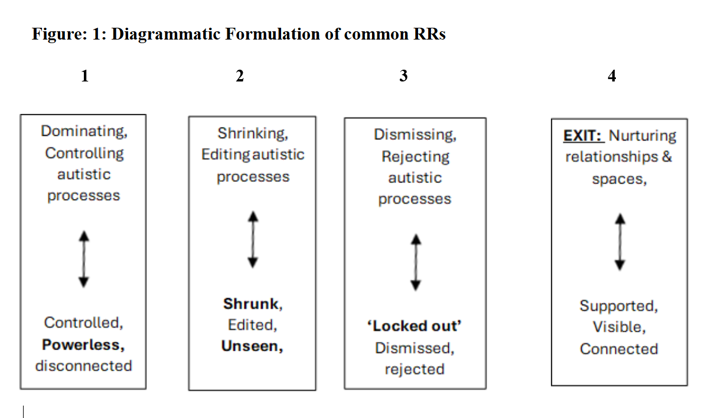
Each role comprised a powerful “doing” and a vulnerable “done-to” position. The ‘doing’ (top) pole is presented as coming from the operation of autistic processes rather than from the individual child, while the ‘done-to’ (bottom) pole is presented as the parent caregiver position. Each RR contributed to the dialogically diminished self-experience of the parent caregiver. It is important to remember that RRs are necessary simplifications and some of the narrative examples could be used across all RRs. Some top pole examples associated with autistic traits, and some also represent societal pressures and experiences. This is my attempt at “naming and unravelling a common, shared but hidden history” (Holland 1990, p. 263).
a) Dominating / controlling to powerless / controlled reciprocal role
From the global consequences for the family, to the subtle nature of inter-personal micro-interactions, this RR operated in a multiplicity of ways. A defining narrative amongst all mothers was that autism had overwhelmed and dominated their lives. Caring for their children had generated an increased burden of stress that required a complete recalibration of the family’s functioning. Most mothers, but not all, articulated anger, and resentment from the frustration that the parenting experience was not what they had hoped for or envisioned.
In terms of interpersonal interactions, most mothers spoke to repeated experiences of feeling ‘directed’ and pressured by autism-induced rigidity, exhibiting behaviours in response to their autistic child in the ways in which the child wanted them to, as opposed to responding authentically. One parent spoke about how her son insisted that she use certain words and phrases in a certain voice, to replicate his favourite cartoon character, and if she didn’t acquiesce, a severe ‘meltdown’ would ensue. Another mother spoke of her son’s insistence on specific aspects of everyday life, with an utter resistance to change regarding how he was approached or touched, or the plate that was used for dinner, the angle of the remote, the only pair of shorts that could be worn. Through years of reluctantly complying, most mothers reflected on this as a ‘learned resignation’ of their personal participation in the dyad, which elicited feelings of powerlessness, irrelevance and being controlled.
Dialogically, this common encounter falls at the extreme end of non-dialogical as the contribution of the other is denied. According to Kimber-Rogal (2008): “Persistent and intractable fixedness in relation to another is the antithesis of an openness which enhances human affiliation” (p.28). One mother remarked:
“He doesn’t know who I am, besides the person who gets him what he wants. I am so disconnected. There is no mutuality.”
b) Shrinking / editing - shrunk / edited reciprocal role
A second shared and primary RR was the experience that autistic processes could shrink and edit the self-experience and world of the mother. By virtue of caring for their child, most mothers spoke to a lessened self, mirroring the reduced realities that had become available to them to inhabit. From feeling forced to leave paid employment to marriage breakdowns, most mothers felt that there had been a restriction in their capacity to inhabit a broader range of identities. One mother brought in photos from her ‘past life’ at work, as a busy PA in a hospital, and said, “this is who I used to be.” She offered a powerful dialogic encapsulation of the relational cost of severe autism to her when she said:
“It’s been like a two-folded living grief, watching him and witnessing me.”
These words not only spoke to the distress of chronic caregiving but also to the presence of an on-going, inter-dependent grieving process.
c) Dismissing / rejecting - dismissed / rejected / unseen reciprocal role
One mother admitted that her son was simply “too much” for her parents to cope with. This perceived rejection of her son was also experienced as a rejection of herself - in her words: “They don’t want us.” This statement hung suspended in the therapy room that day and seemed to me like this mother was speaking to a super addressee, perhaps to society itself.
Tustin (cited in Ashton, 2018) acknowledges that “for many, indifference on behalf of the other is the very worst thing as it implies you do not exist for me.” Consistent with this shared narrative, Bakhtin (1986, cited in Ryle and Kerr 2020) described a lack of response as a form of hell, “as absolute lack of being heard” (p.126).
When I showed her the quote by Ryle (2001): “We interact and communicate, therefore I become” (p.10). She responded instantly: “Well, no wonder then, I get ignored and rejected and I come undone.”
These three most common RRs and procedures emanating from these mothers offered a chance to articulate and comprehend their relational experiences. This confirmed their diminishing experience of self through the other, the very heart of the dialogic experience. The reformulation of severe autism as a relational disorder, and the understanding of how our sense of self comes from the other, enabled some mothers to make sense of their experiences and to find new opportunities (exits) to re-connect with themselves within this role.
Theme 2: Links were made between historical relational patterns and current distress
In the context of chronic caring, for two of the mothers, this ‘unseen’ state was entirely familiar and highly distressing, experienced at times as “annihilating and unbearable.” On the unfolding of childhood stories, the distressing RRs of neglecting / dismissing to neglected / dismissed and rejecting to rejected, already existed. For one parent, it was her experience of an over-controlling, critical mother that elicited this echo chamber feeling. For the other mother, it was growing up with a narcissistic, abandoning father that saw the origin of these painful RRs. Through therapy, we explored the idea that we each have ‘anticipated others,’ which is particularly significant when caring and parenting a child who has limited relational capacity to engage dialogically. It was clear that when ‘gaps’ were experienced in autistic relationality, the silence invited the ‘anticipated other,’ unless conscious awareness is brought to bear. Becoming united with their emotional history enabled some mothers to understand why they may be primed to feel ‘rejected’ by their child. One parent caregiver said:
“Deep down I thought I just don’t matter to him, not really and that’s why he didn’t see me or respond to me. I never realised that he does that because he doesn’t really see himself either, he just isn’t aware of people the way I am and realising that just took the puff right out of my pain, something shifted for me, in learning that.”
The consequence of this finding is that supporting the psychological needs of parent caregivers cannot be decontextualized and removed from an understanding of their early lived experience.
Theme 3: The dialogic alliance engendered new relational capacities
It was clear that certain elements of the CAT therapeutic relationship provided a reparative dialogical counterpoint to the relational indifference and dismissal experienced by many of the caregivers with their autistic child. My presence as a responsive other enabled the parent caregiver to experience understanding, being listened to, waited for, validated, allowed, invited, and wondered about. The CAT model was experienced as a radically powerful fit for these parent caregivers, one of whom, on suddenly recognising herself in her own voice, said aloud: “ah, there I am” - the experiencing of a dialogically attuned relationship facilitated her ontological self-experience. As Bakhtin (1986, cited in Ryle and Kerr 2020) said:
“I am conscious of myself and become myself only while revealing myself to others” (p. 38).
Research by Oppenheim et al, (2007) referred to a parent’s discovery that their child has autism as a “metaphorical loss of a child” (p. 109). However, what struck me in the provision of CAT was the absence of the acknowledgement of the co-occurring and inter-dependent reciprocal loss of the dialogical self of the parent. One mother reflected in her goodbye letter:
“I knew life changed the day we got his diagnosis, but it wasn’t until I went through this therapy journey that I found a way to say it that feels right. I can see now that I lost more than my son to autism; I lost part of me too, literally. I can recognise now that I got plugged out (disconnected) from my life and lost the ways I had of experiencing myself with friends and family. It was like our whole world became autistic: predictable, small, and rigid. No wonder I was depressed. Life continues to be challenging but at least I know that getting plugged back in will give me more of me back.”
Bringing a dialogic conceptualisation to conditions like autism brings the relational ‘other’ into view. It helped this parent to generate a new way of relating to herself and a new RR emerged: realistically caring to realistically cared for.
Reformulation actively broadened the participating mothers’ capacity for conscious reflection and enabled the understanding that, although we develop RRs throughout our lives, severe autism tends to impose relational patterns. A CAT dialogic understanding of the co-construction and maintenance of self through the other, enabled mothers to re-frame their autistic child’s impaired relational capacity and to forge a different relationship with their self-experience. In time, this enabled a move to a more compassionate position towards themselves and their child.
Enactments and Countertransference:
A key aim in CAT is for the therapist to recognize and not collude with the re-enactment of limiting or harmful relational patterns. Ryle and Kerr, (2002) identify the therapeutic relationship as the medium which enables the patient to become aware of their own processes. I became aware of how, at times, I was being elicited to reciprocate the super-carer position for some mothers and in this regard, I often found it difficult to withstand the pressure to ‘act’ rather than to sit with the feeling. At other times I felt like I was at the bottom pole of the first RR, powerless and overwhelmed in relation to a dominating and harrowing narrative. I often felt the need to defend against unbearable feelings of helplessness and could find myself wandering into a social worker position looking to advise or inform. More than once, I had to say to a parent: “I’m sorry, I have become the non-verbal other, I don’t know what to say.”
I became aware of how I often experienced intensely negative feelings towards some of these severely autistic children. I found myself resenting them, for the pain and misery they had caused these lovely women. I was aware that these mothers were living my idea of a nightmare; trapped by dependent, endlessly caring roles. Teenagers being described as “eternal toddlers” counter positioned the caregiver as an “eternal parent,” and those words filled me with an interminable dread. I realised that I was being elicited to hold the hate as it were, the disavowed feelings that were too dreadful for some mothers to express. Acknowledging and naming the transference and countertransference within the therapeutic relationship enabled most mothers to discover that neither they nor the therapeutic relationship would be destroyed by painful or aggressive feelings. Having an individual map with each mother enabled these positions to be represented and triangulated, making complex relational exchanges and the links that connected them, more transparent and understandable. Weekly supervision helped in this regard.
Engaging with personal therapy during this period was illuminating in realising my own positions. Returning to my original motivation regarding my own mother and exploring dialogically compromised dyads, my therapist said to me that “maybe these mothers with autistic children who cannot reciprocate their love and care may represent something important and meaningful to you” I considered if perhaps I was in the reciprocal part of their partnership, experiencing a mother who struggled to reciprocate her daughter’s love and care. In sum, a dialogic lens returns us to the essence of our humanity, understanding what we are driven to seek out relationally despite the limits of what may be available and how our experiences of these relational gaps can reveal much more about ourselves and our ability to survive love, loss and longing.
I am an Irish psychologist working in Dublin who recently completed IRRAPT training and loved every minute of it! I can be contacted at: aoifecatpsychotherapy@gmail.com
NB: I am aware that I use of the term ‘severe autism’ instead of ‘neurodiverse. My reasoning is derived from the families I support. One dad said to me: “that word – neurodiverse - does not represent my son or the extent of his needs. It’s not like he’s just a bit quirky and will find his groove on a beanbag when he works for Google, he’s twelve and he can’t talk.”
References:
Ashton, P. (2018), From the Brink: Experiences of the Void from a Depth Psychology Perspective, New York: Routledge.
Holland, S. (1990) Psychotherapy, oppression and social action: gender, race and class in black women’s depression. In: R.J Perelberg & A.C. Miller, eds. 1990. Gender and Power in Families. London: Routledge. Chapter 14, p 256 – 269.
Kimber-Rogal, N., 2008. Relationships and CAT. Reformulation, Winter, pp.28-29.
Oppenheim, D., Dolev, S., KorenKarie, N., Sher- Censor, Yirmiya, N. & Salomon, S. (2007). Parental resolution of the child’s diagnosis and the parent-child relationship. In D. Oppenheim & D, Doldsmity (Eds.), Attachment theory in clinical work with children (pp.109-135). New York: Guilford Press.
Ryle, A., and Kerr, I.B. (2002). Introducing Cognitive Analytic Therapy: Principles and Practice. John Wiley & Sons: England.
Ryle, A. and Kerr, I. (2020). Introducing Cognitive Analytic Therapy: Second Edition, Wiley & Sons Ltd.