


Vicky Petratou, 2025. Recognising the slippery slope of good intentions in the practice of CAT- helping our clients to see how the pleasing trap might be less pleasing than we think
In this article I am going to summarise some reflections on how focusing on intentions, and their impact, in creative ways can help with the therapeutic task of noticing and revising problematic patterns as they arise. I recently have written about this (Petratou, 2024) and explored these ideas in a workshop that I facilitated in the 2024 ACAT conference.
There are multiple ways of experiencing and perceiving our patterns of relating within the same relationship – we can experiment with those and learn from them. Creative explorations can help us to develop our awareness of the negative ‘impacting’ parts of our Reciprocal Roles – those abusing, neglecting and overbearing parts (even those which have ‘good or protective’ intentions) and grow our ability for compassion towards the ‘impacted part’ of the Reciprocal Roles. In therapy we can use a variety of methods - experimenting with role-play and role reversal improvisations, projective creative techniques and storytelling/making can all be of help in this process.
Reciprocal roles and the impact of subjective Intentions in action-impact reciprocal role taking
When exploring the recognition of a particular reciprocal role we often come to realise that the same situation can be described by two very different reciprocal roles. An example of this is demonstrated below:
Parent: ‘Make sure you get the last train back home; I will be waiting for you’ – the parent thinks that in terms of Reciprocal roles she is protecting and caring and believes that her adolescent daughter will feel protected and cared for as a result.
Adolescent Daughter: ‘Why is mum such a control freak! She’s so annoying – she never trusts me’.
In looking at the reciprocal roles being played out here, which version of events is the ‘real’ reciprocal role? Is it ‘Protecting to Protected’ or is it ‘Controlling to Controlled’? There isn’t one correct answer. Each participant has a different subjective reciprocal role experience.
Most people tend to justify their actions and believe that they have good intentions. Even when we feel we are helpful we may harm those around us, especially when we are convinced that what we are doing is the correct thing to do. Usually in these circumstances, if we don’t have curiosity about the impact of our actions and a willingness to witness, accept and inform ourselves about them, then we may be maintaining a vicious cycle of stuck-ness in communication, problematic conflict and disconnection.
I have drafted a map of these relational dynamics by tracking the micro communications of two people who share an intimate relationship. Meet Bob and Barbara, who often find themselves sliding down, what I have termed, ‘The Slippery Slope of Good Intentions’, where intention and impact never seem fully attuned, leaving both participants in an increasing state of distress and disappointment …
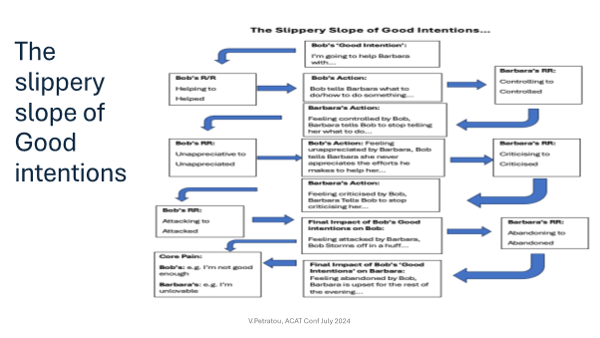
One therapy goal is to help our clients to feel compassion for their neglected, abused and smothered parts, at the same time as helping them to become more accountable and more able to acknowledge their problematic reciprocal role procedures in non-blaming and non-shaming ways. Recognising how they may perpetuate these problematic reciprocal roles, with themselves and others, is then the next step. Helping Bob and Barbara to recognise the role each of them is playing in ‘The Slippery Slope’ would help them to reduce how often they become entangled in this way. But how best to approach this?
Starting with the impacted side (bottom up)
Mrs Doyle from the Irish sitcom ‘Father Ted’ is a character who is obsessed with ‘pleasing’ everyone she knows (including Father Ted) by making them cups of tea; forcing them to accept her tea whether they want tea or not. Mrs Doyle seems oblivious to the negative impact that this can have on the recipients of her cups of tea, believing that she is ‘pleasing’ others with her offerings.
Examining the Reciprocal Roles between characters from fictional works creates dramatic aesthetic therapeutic distance, which is helpful in working with a client’s issue that might have been quite difficult to address or discuss in other ways. When working with one client, reflecting on her ‘internal Mrs Doyle’ (Petratou, 2024, p107) helped us to see how intention and impact can often get out of step, and that imposing your wish to please others (whether they want it or not) can be experienced as intrusive.
This example illustrates how it is often more useful therapeutically to look at the ‘impacted’ side of the Reciprocal Role first, rather than the ‘impacting’ side, as this usually gives us a clue as to whether the client might need to consider introducing change into how they relate with others or not. For example, if I asked Mrs Doyle what was happening between her and Father Ted when she was insisting on making him unwanted cups of tea, she might tell me ‘I’m being kind to him because he loves the tea I make him’ (‘impacting’ position, the top part of the Reciprocal Role). However, if I invited her to reflect on what it might be like for Father Ted to be forced to accept tea that he didn’t really want she might be able to begin empathising with his experience of feeling overwhelmed and distressed by her ‘well-meaning intentions’ (the ‘impacted’ position)’. (Petratou, 2024, p:107).
You must fit my bed … or else!
The impact of the actions of Procrustes, a character from Greek Mythology, shows the darker side of a self-righteous, dismissive pleaser/rescuer self-state. He used to either cut his guests feet off while they were sleeping (if their legs were too long for the bed) or he would stretch their legs to breaking point if they were too short. His story metaphorically portrays some peoples’ need to control and harm if the other doesn’t fit their expectations and shows how this can end up with unintended and unwanted (even traumatic) consequences. Like Procrustes, we can end up acting in dehumanising and intrusively violating (abusive) ways when we are convinced and determined to make others satisfy our expectations and desires. In these circumstances we can often fail to notice the pain this is causing. When sharing this story in therapy, I find that it can help clients realise that others can often have quite different needs to them and that some things that we might find desirable and useful may not meet/address the needs and wants of others.
Procrustes had a compulsive desire to control and manipulate his guests and his story can be seen as an exaggeration of how ‘dismissing to dismissed’ and ‘controlling to controlled’ reciprocal roles can have negative consequences because of a failure to decentre from our own assumptions of what is right which obscures our ability to notice or appreciate the wants and needs of others. It also functions as a reminder of the negative impact that the controlling/top part of a reciprocal role can have and the importance of respecting physical and psychological boundaries in relationships. It can also remind us that regardless of how good we think we are, our actions can have unintended and harmful consequences on others. In CAT therapy, it is helpful to facilitate a therapeutic environment where we can explore how the impact of our actions may be perceived and experienced by others and to reflect on whether our actions are truly meeting the needs and wants of those around us. In this way, we can start to explore the importance of recognising and respecting the unique needs and differences of others. This story can also help us to re-ignite our sense for empathy and compassion: Understanding the impact of our actions on others and allowing ourselves to experiment with regaining our capacity to be kind and respectful.
Listening and relating to this story helped one client to realise that a familiar Reciprocal Role that he often engaged in with others could be experienced by those affected more as ‘harming to harmed’ rather than ‘protecting to protected’. In our work together, the image of Procrustes became a key reminder of how this ‘harming to harmed’ relational pattern can very easily, and almost imperceptibly, end up dominating their experiences with others. By examining the impacted side of the Reciprocal Role first, clients can gain a better understanding of how their actions may be perceived by others and how they may unintentionally cause harm or tension in their relationships. This approach allows for a more compassionate exploration of their habitual relational tendencies, leading to potential growth and change in how they relate to others.
In therapy, it can also be very useful for therapists to analyse their own Reciprocal Roles in response to clients' behaviours (their countertransference). By examining how they react verbally and physically to aggression or demands from clients, therapists can gain insight into their own triggers and patterns. Through self-reflection and empathy, therapists can effectively navigate challenging interactions and create a safe space for clients to explore their own relational patterns. When doing this we need to ensure that whatever creative resources therapists bring to the therapy space they have to be meaningful to the client and within their ‘zone of playful proximal development’ (Sullivan, 2024, p 58).
Exploring how we experience Reciprocal Roles in relationships can provide valuable insights into our behaviours, intentions and the impact these can have on others and ourselves. By examining these dynamics with compassion and creativity, we can cultivate more mutually respectful, attuning and accountable relationships in our lives.
References:
Petratou, V. (2024) Dramatherapy and playful relationality. In Y. J. Stevens (ed) Creativity and Mental Health – A Cognitive Analytic Approach to Integrating Play and Imagination in Psychotherapy, Supervision and Training, pp: 93-109.
Sullivan, P. (2024) The Zone of playful proximal development. In Y. J. Stevens (ed) Creativity and Mental Health – A Cognitive Analytic Approach to Integrating Play and Imagination in Psychotherapy, Supervision and Training, pp: 51-65.
Vicky Petratou is a CAT Psychotherapist, Dramatherapist, Clinical Supervisor & Trainer working both in private practice and for a number of NHS trusts and voluntary organisations. She is passionate about engaging with embodied, imaginative and playful approaches in therapy and life in general!
She can be contacted on Vicky.Petratou@slam.nhs.uk or vp.therapy@protonmail.com