


Kate Younger, 2025. Adapting the CAT framework for use with Couples: is anyone else doing this??
My journey in developing a CAT-informed couple model
I have long held an interest in thinking and working relationally – it is a big reason as to why I was drawn to CAT as a model. During my clinical psychology doctoral training, I had been supervised by a systemic therapy trained psychologist on one placement and did a specialist placement at the Tavistock Clinic working psychodynamically with couples. So, I knew early on in my career that I enjoyed and valued working relationally.
During my first NHS post-doctoral position, I encountered Mog Scott-Stewart (psychodynamic psychotherapist, CAT psychotherapist and supervisor), who imparted her knowledge and enthusiasm for CAT with me and in turn encouraged me to do the practitioner training. And so, I went on to complete the two-year training and CAT quickly became my primary model of choice. I fit with CAT and CAT fit with me.
After leaving the NHS some ten years ago and moving into private practice, I have continued to use CAT as my primary 1:1 model of therapy, the main difference being that I use it both within the prescribed time-limited framework of CAT proper and as an open-ended approach. I use it across diagnoses and typically interweave EMDR when appropriate.
Alongside my relational interest in therapeutic work, my NHS work saw me hone my skills in working with people with traits consistent with, though not always being diagnosed with, a personality disorder. Primarily, borderline and narcissistic personality frameworks. I have continued to be especially interested in working with people with these personality traits in my private practice work.
While employing CAT with individuals, I started noticing that despite good movement happening in the therapeutic room between us and within the individual themselves, what seemed to be tripping them up or being tripped up was their relationship with significant others – most notably their partner and often, family members and friends. This finding didn’t surprise me, as it fit with the findings of my doctoral dissertation – the impact of individual therapy on the couple relationship. A tentative finding was that there could be a reciprocal impact between individual therapy and the intimate relationship in both directions – constructively and at times, destructively. This was not conclusive and required further research, which I have gone on to do anecdotally in my career. Others have also written about this observation directly with CAT. Jenaway (2019) for example wrote for ACAT about ‘How Might Having Therapy Affect My Relationship’, specifically flagging how with CAT she gives prospective patients a ‘marital health warning’ before commencing therapy.
Ryle (1991) himself also wrote about CAT and couples. And in this chapter, he observed similar limitations in only working with individuals. Further, in sharing some case studies, he also noted a similarity in the couple’s shared reciprocations. More so, that these deviated in how they played out for each individual. This has absolutely been the fascinating discovery point I have had with using CAT with couples – that they more often than not share a core reciprocation, it just gets taken up differently. For example, a reciprocation of compromised care to feeling unseen in one couple, manifests as getting bigger and bigger (e.g. louder) from one partner, whereas for the other partner they become smaller and smaller (e.g. like a ‘church mouse’) in the relationship and room. While Ryle made some suggestions on how to do CAT with couples, he did not offer a clear formula and rather gave flavours of using individual CAT techniques with couples.
I then started to think about ways that I might be able to incorporate a more direct systemic approach – having both people in the room – using the basic principles of CAT. My affiliation with a clinical practice (www.thebluedoorpractice.com) which privileges relational thinking and working, facilitated this process. We are an organisation that really operates as a team, sharing clinical information across the team, with patient consent. For example, I may be working with an individual and another team member may be working with the couple. Discussions would often demonstrate how what I was seeing and hearing in the individual session was not playing out the same or being accurately reflected in what was being observed in the couple therapy sessions. More so, I observed how the individual could easily get caught up in a pathologised position as ‘the problem’ in the individual setting, and this inevitably contributed to them staying stuck in their relational patterns. I imagine this observation would not be surprising to proponents of systems theory (i.e. the core theoretical framework behind systemic therapy). Here, it is held that by working with various parts of a system (e.g. a couple or a family) real and sustainable change occurs because intervention occurs at multiple levels and further, the system is responsible for change, as opposed to an individual (Bertalanffy, 2015).
And so, I started wondering if I had a resource within myself as the only CAT therapist in the team, whereby I could use the CAT techniques to not only help the primary partner, but also the couple and the other partner in a more CAT-centric way. I did find some articles, especially in Reformulation, expressing an interest in doing couple work with CAT (e.g. Gray, 2006), but none that articulated the formulaic approach undertaken. This feels important in adapting CAT as it is a theoretical model with key stages. While there is an analytic part – which I am grateful for as it creates an unstructured, exploratory feel – there are key stages and approaches that are intrinsic to making CAT, CAT. This article therefore, shares some of my key approaches to adapting the CAT model for working with couples, and seeks to move it forward as a model, within a model.
Couple work population
There are two groups into which I categorise my CAT couple work. First, those where I have done an individual CAT therapy and we have then collectively decided to invite the partner into the therapy. And second, those who have sought me out for couple’s work from the outset, and where neither partner is known to me. The primary difference I notice between the two categories is that there is possibly more ‘buy-in’ with the former because I have a strong working relationship with the primary partner and this helps drive and support the couple’s work. I had initially worried that the partner entering the established therapy relationship may feel on the outside or biased against. Or, a concern that the original patient may feel less attended to. Overall, I have not found these to be a problem and anecdotally this has been confirmed by several partners. Of course, there have been a couple of exceptions to this – but that could be another paper altogether! That being said, I do protect against ruptures as much as possible by setting it up at the outset that I am on the side of the relationship, regardless of pre-existing familiarities and that I consider a relationship to be a shared responsibility and so I will be identifying the bits each partner may be bringing that is collectively tripping the relationship up dynamically. This latter part has been informed by my interest in the systemic school and ideas created by Relational Life Therapy (c.f. Real, 2022).
My couple work CAT formula:–
There is a ‘set’ formula of sorts that I have tweaked over time, which I will share here. I am aware of other clinicians within the CAT network developing their own couple-based CAT approach (e.g. Cherry Boa), and so I am hoping that this article will shed further light and continue conversations around developing this approach. I am not saying mine is perfect.
1. Meet with the couple together and get an understanding of what they are wanting from the couples work and their views on what seems to be tripping them up. And also gather transferential information of the relational dynamics. NB: I do not use the existing psychotherapy file with couples as there then feels too much to hold.
2. Meet with each partner individually to understand their formative blueprint. In the case of already having done an individual CAT, I will already hold a map from our previous sessions. The focus then, is on the partner’s ‘map’, which I hold in my mind / file and do not share, generally. This is typically one or two sessions. In the permutation where both partners are unknown to me, I do on average one individual session with each, and here I try to balance the time spent with them.
3. The Reformulation phase. Use all of the information collated to start developing a shared blueprint / map of their relationship, detailing core reciprocations and unhealthy patterns that are keeping the relationship in a state of turmoil (see example below).
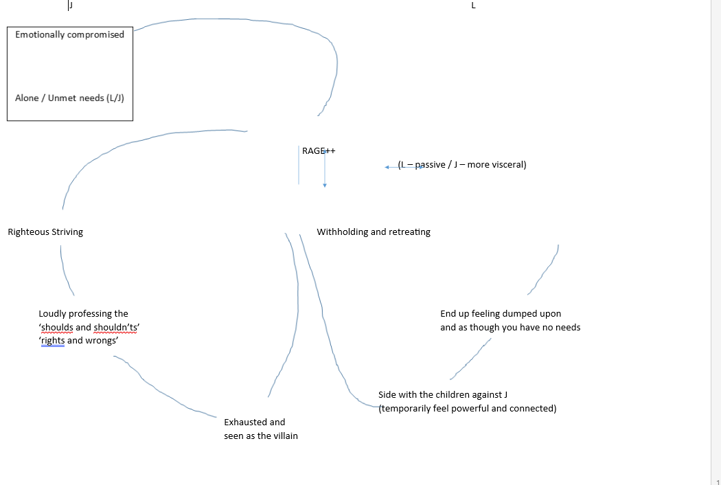
4. The Recognition phase. Meet again with the three of us and share the map in draft form, ensuring a clear and shared understanding by all. Make any amendments to the map as discussed in the session. Key here is that the map highlights the idea that it is a shared responsibility and so shows what each partner is bringing.
5. The Revision phase. From here, the work then shifts towards introducing interventions that are specific to their presenting needs, with a very clear focus on working relationally. Sometimes this is contracted for a set number of sessions and other times, open-ended. On average, I would say that I meet for a total of eight sessions – six as a couple.
Key relational interventions:
-
Feedback wheel (c.f. Real, 2022, for more detail)
-
Sandwich technique – framing observations as ‘positive, negative, positive’
-
‘I. You. We.’ The idea being that none is more important or privileged than the other
-
Giving most generous interpretation to partner’s behaviour
-
Mindful observer – with a focus on understanding self and other’s trigger points and the relational map
-
Losing the narrative of ‘right, wrong, fault and blame’
-
Timeouts – setting the relationship and communication up to succeed
6. At the final session, I present a ‘goodbye letter’ of sorts to the couple. This is probably best described as a mesh of a typical CAT reformulation and goodbye letter in one. The key points I discuss are the unhealthy relationship patterns that brought them to me and the primary interventions I encourage them to hold onto post the therapy sessions ending.
7. Review sessions are arranged as required – as I do in my practice generally, my door remains open to any patient with whom I have completed therapy.
Some concluding observations
The original patient does not tend to continue with individual work post couple work. I have had a few cases where the original primary patient resumes individual work, but more often than not, it is not the norm. My sense of this is that the couple hold the work collectively and so the individual work gets taken up and supported by the couple working together more healthily post couple work. In the cases where the individual work resumes, it is largely because of deep psychological trauma that requires continued individual holding. This can become quite a heavy ‘holding’ as I am then potentially in the position of holding the individual work and the couple work with reviews. It has arguably worked better on all levels when I am only in one of the roles, and not both. Here though, I have found systemic supervision essential.
The overall sense is that the couple CAT work tends to be both more intense and dynamics often shift much more quickly – both interpersonally and intra-personally – when both partners are invested. And so, it may offer a more cost-effective and efficient treatment. Of course, when there is too big of an imbalance in investment from either partner or lack of engagement from the couple and their agenda, like any systemic approach, the therapy doesn’t work.
As alluded to earlier, my development of this CAT adaptation has been partly influenced by my interest in Terry Real’s Relational Life Therapy (c.f. Real, 2022), especially some of the relational interventions. That being said, the bits that feel acutely unique to the CAT model are the construction and giving of a map and combined reformulation / goodbye letter. These become very tangible objects for both the couple to hold onto and which also concretise the idea of shared responsibility.
So, my questions now are, is there enough interest to take this forward more formally, including with research and further specialist CAT training and/or supervision, and how can we go about doing this as an organisation? As I noted, I am aware of others doing something similar with CAT. Further, the very relational nature of CAT affords it the natural application to couple’s and broader (e.g. parent and child) systemic work. Between the time of first writing and this article being published, a SIG was set up and I am hoping that this will be a good source for challenging, developing and establishing a model further.
Potential research options
It would be great to do some more formal research on the CAT couple-work. In particular, taking more formalised baseline measures pre and post therapy (e.g. Persons Relating to Others Questionnaire; Birtchnell, 2001). And, looking at whether there is a difference between the outcome of the couple work where one of the patients are already known versus a completely novel couple. We could perhaps look to existing systemic therapy research for how best to structure this research. I also feel that there is perhaps work to be done in developing a couple-based psychotherapy file.
Kate is a Clinical Psychologist, CAT Therapist and EMDR Therapist. She now works solely in private practice at the Blue Door Practice in London, offering both in-person and online sessions globally, with individuals and couples. She is in the process of publishing the following book:-
My Little Black Book… of therapy tips and tools (Younger, to be published 07/2025)
kate@thebluedoorpractice.com
References
Bertalanffy, L. (2015). General System Theory: Foundations, Development, Application. New York: Braziller
Birtchnell, J. (2001). Relating Therapy with individuals, couples and families. Journal of Fmaily Therapy, 23, 63-84.
Gray, M. (2006). Musings on Doing CAT with Couples, Reformulation, pp 29-31
Jenaway, A. (2019). How Might Having Therapy Affect My Relationship, Reformulation
Real, T. (2022). Us: Getting Past You & Me to Build a More Loving Relationship. New York: Rodale Books
Ryle, A. (1991). Cognitive-Analytic Therapy: Active Participation in Change. UK: Wiley & Sons Ltd
Younger, K. (2008). The Reciprocal Impact of Individual Therapy on the Couple Relationship. University of Essex: DClinPsych Publications