


Recent posts
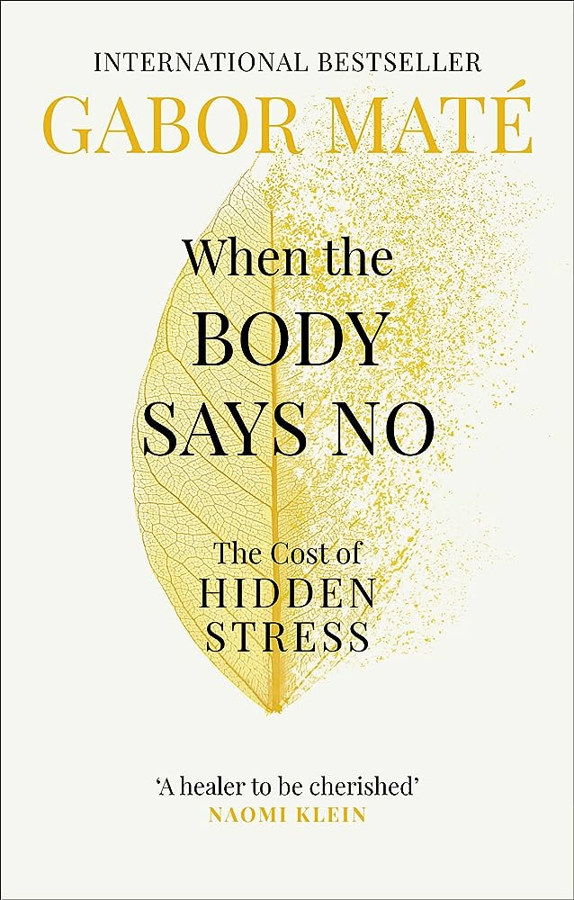
Hicks, K. 2024. When the Body says No by Gabor Mate. Reformulation, Winter, p.24-25.
Publisher of most recent edition Vermilion (2019)
Reviewed by Kathrin Hicks
Many of us are drawn into the world of psychology and psychotherapy by a Thing – an idea or a concept or a particular area of clinical application – something that captures us in some way. My Thing was the discovery of the discipline of psychoneuroimmunology as an undergraduate in the mid 90s. Once I’d got over the mouthful of a term, I was fascinated by accounts of how social and emotional wellbeing mediate stress and therefore the immune system. Correlational studies that showed how loneliness was associated with an increased risk of a whole collection of different illnesses. Experiments in which people were infected with the common cold virus and then systematically stressed (usually with maths problems), or not, with results showing that the stressed ones were more likely to actually get a cold. The remarkable effects of using imagery, particularly with children, to “zap” cancer cells and shrink tumours. I hoovered it all up, for once reading far more than was strictly required for this particular module, lost in wonder at the intricacy of the mind/body connection.
Three decades on, I work as a clinical psychologist for the cancer charity Maggie’s. The bulk of my post-qualification experience has been in physical health and I have held this work within a CAT framework from the start. Therapy is essentially about meaning-making, and working with this particular client group, a lot of that meaning-making focuses on the why of the illness. I discovered Gabor Maté’s book via multiple recommendations from patients with whom I was having these sorts of conversations. I would go so far as to call it an essential read for anyone working at the interface of mental and physical health and a fantastic resource for understanding the origins of illness in a holistic, non-blaming way.
The central premise
At the heart of this book is the idea that it is meaningless to differentiate between “mind” and “body” in health and illness. It is essentially an exposition of how the psyche, the immune system and the endocrine system interact, described by Maté as interlocking cogs of one single system that is constantly mediated by daily experience. Maté systematically goes about explaining how (emotional) stress gets transmuted into (physical) illness. The title of the book reflects one aspect of this process: “When we have been prevented from learning to say no, our bodies may end up saying it for us.”
Developing the argument
Having introduced the central premise of his argument, Maté develops this by focusing on different illnesses and different emotional and relational issues in turn. He writes about Amyotrophic Lateral Sclerosis, so strikingly associated with being nice that nurses’ ratings of how pleasant patients are to interact with are a surprisingly accurate predictor of a positive diagnosis. About Alzheimer’s Disease and emotional repression. About cancer and a dearth of fulfilling, truly connected interpersonal relationships. Many of the chapters have titles that read like captions for a CAT diagram: “The Little Girl Too Good to Be True;” “Buried Alive;” “Never Good Enough;” “It’s All in Her Head.”
Finally, Maté turns to the question of what we do with this understanding in order to promote healing and health. He refers to “The 7 A’s of Healing:”
• Acceptance: an acknowledgment of how things are, incorporating compassionate curiosity
• Awareness, of both physiological and emotional responses, which includes not only recognising these responses but trusting them
• Anger to help us stand up for ourselves
• Autonomy, relating to the issue of boundaries and an internal sense of control
• Attachment: in order to be healthy we need to be connected
• Affirmation of our own creative self and of our connection to the universe and all there is
A note on the writing which, aside from a degree of unwieldy terminology (psychoneuroimmunoendocrinology!) is elegant and flowing: Maté has a beautiful turn of phrase and illustrates his points with stories of patients’ experiences and personal reflections. The overall result is engaging, gripping even, conveying often complex ideas in a deceptively simple way, always with a deep sense of just how much the author cares about all of this. I found myself genuinely moved by his writing, to laughter as well as to tears.
CAT and the Body Saying No
The idea that I found most striking from the point of view of understanding illness through a CAT lens was the notion of a “confused” immune system. Autoimmune conditions essentially involve the body attacking itself, whereas succumbing to viral or bacterial infection could be thought of as the mirror image of this, with the body failing to attack that which is threatening. Maté relates this, at an emotional level, to what he terms “boundary issues,” linking the ability of the immune system to recognise what does and does not belong to the body to the developmental task of successfully and appropriately differentiating self and non-self.
The 7 A’s of healing also resonated strongly with my CAT understanding of health and illness. As a list, they read like typical exits from problematic patterns, or healthier ways of being.
Limitations
I don’t have much to criticise about this book but there are two areas that I would raise perhaps not so much as a criticism as something that I hope might be built on in future writing: Firstly, I was surprised that any of this should be startling news a couple of decades into the 21st century, having come across these ideas in similar form as an undergraduate. However, I note that although the UK edition of this book wasn’t published until 2019, the original first came out in Canada in 2003, which would explain a sense of it being less than cutting-edge. Secondly, what remains unclear is how and why some people develop certain illnesses and not others. The same emotional stresses can lead to different illnesses or to none at all, and these different pathways are not properly accounted for. It will be fascinating to see how our understanding in this area might develop.
Conclusion: Applying this book in my clinical work
As I mentioned at the start of this review, many of my clients come to me wanting to be able to answer the question “Why did I get cancer?” There is often another question implied by this first one: “And what can I do to prevent it coming back?” These questions arise from a sense of helplessness (for example, being told that the cancer is genetic or, often worse, that “it is just one of those things) or self-blame. I find that Maté’s conceptualisation helps people to make sense of their experiences in a non-blaming, empowering way, helping them to see not only how their way of being in the world might have contributed to them becoming ill but also offering a way out. I would go so far as to say that this book should go on a list of essential reading for any psychotherapist who works with (physical) health issues.
Kathrin’s brief Biography: “I'm a clinical psychologist and CAT therapist and I've been using CAT in physical health contexts since I first qualified in 2006. I have a particular interest in the integration of mind and body in therapy and consider myself lucky to be able to pursue this in my work for the cancer charity Maggie's. In my personal life, music, meditation, yoga and dancing in local woodlands help me to practise what I preach.”