


Recent posts
Jenaway, A., 2024. Review of the Book Launch and CPD event for the Oxford Handbook of Cognitive Analytic Therapy on 25th April 2024. Reformulation, Winter, p.13-14.
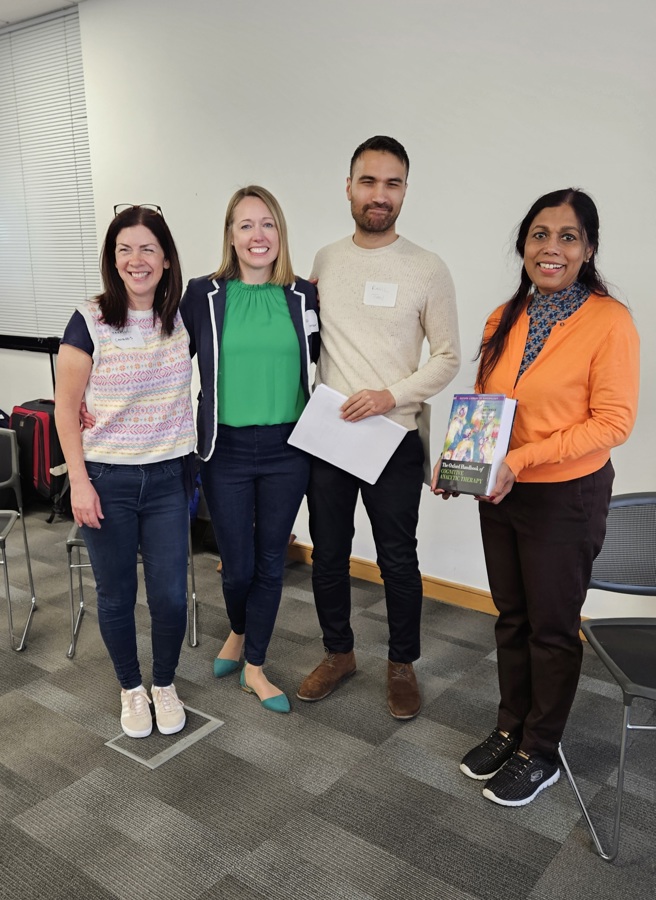
"The three editors being congratulated by Jessie Emilion, Chair of ACAT"
It was such a pleasure to attend this day, set up to celebrate the launch of what feels like a new “go to” reference book for CAT. There was a real buzz in the air as so many of us met in person after our new normal of many months of online meetings and events. This was highlighted by the three editors of the book telling us that this event was only the second time that they had actually met in person, despite a huge amount of work and liaison between them to get the book over the finish line. Ranil Tan started the presentations by illustrating the extensive mosaic of collaborations that were involved in getting contributions from 75 authors, plus additional input from experts by experience. The editors also spoke about their desire to include artwork that had been submitted for the book cover by therapists and clients and they showed some of the work through their talks.
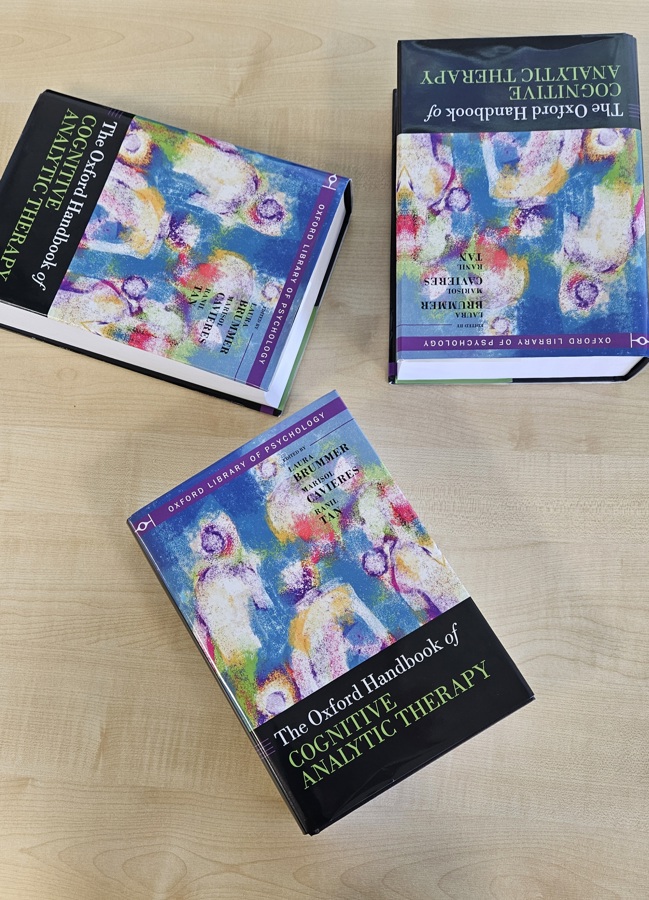
"The book cover illustration by Shanali Perera”
The day continued with presentations from various chapter authors. Rhona Brown talked about her chapter on “CAT in Social Context”, prefacing with her experience of being invited to sing with her choir at a football match and the surprising visceral impact of the “boos” from the fans of the other team at the opposition end of the pitch. This was a reminder of all the assumptions we make about the world will respond to us, and the power of mismatching information. Rhona’s chapter is an exploration of how recognition may not be enough when our client is experiencing overwhelming social or cultural pressures, where exits consisting of social action with others may work better. She also talks of how we may need to revise some of our CAT tools in order to “decolonise” CAT. The embodied effect of the “boos” was referred to later in the day by Tim Sheard as he discussed his chapter “Embodiment as a relational Resource in CAT When Working with Developmental Trauma”. Tim’s message was about how helpful it can be to us, as therapists, to tune in to what we are experiencing in our bodies as a way to remain present and available in the face of things which our clients cannot be put into words. He has tried out this method in workshops with CAT therapists over several years, often using self-drawn images to explore the therapist’s experiences.
Two other presentations focused on chapters from the section of the book on applications of CAT in specific client groups. Sarah Douglass talked about her chapter on using “CAT in the Perinatal Period” and spoke movingly about how helpful it can be to work relationally with parents, usually mums, who are struggling with “Ghosts in the nursery” and enacting old reciprocal roles from their past experiences with their babies. Sarah has been using the “Baby map” or developmental diagram that I described in a paper in Reformulation (Jenaway, 2007) and I was very pleased to hear about these ideas being extended in this way. Sarah’s talk tied in nicely with Susie Black’s work using a generic “cancer map” as part of her work at Maggie’s in South Wales. The generic CAT maps were developed with cancer sufferers and staff teams and Susie has become a bit of a champion of the use of generic maps. Although no longer working at Maggie’s, she is helping others to develop similar generic maps for other services to use. Her chapter, written jointly with Jason Davies, is on “CAT in a Cancer Setting: Working with People with Cancer, Carers and Staff”.
Towards the end of the day, the focus turned to the section of the book on using CAT within and across systems, with two presentations. Sarah Craven-Smith and Jayne Finch talked about their chapter “CAT consultancy for Enhancing Team Functioning” with a focus on finding ways to map with staff teams without causing a feeling of blame or defensiveness. Lastly Sue Walsh and Kate Freshwater discussed key messages from “Struggling well: using CAT to Make Sense of Organisational Hurt” which emphasised how every level of the system can be under pressure and how important it is for us all to be able to mentalise and continue to think about what is needed to maintain the system as a care giving one according to client need, rather than an industrial provider of treatments. They recommended using stories as exits in order to capture the complexity of systems where there are no easy answers.
I really enjoyed the day and have also been dipping in to the book over the last few months. It is an expensive buy in Hardback but hopefully will start to appear in libraries and on team bookshelves, and be borrowed from friends, so that we can all benefit from the multiple voices brought together within.
Alison Jenaway
Reference
Jenaway, A. (2007) Using Cognitive Analytic Therapy with parents: Some theory and a case report. Reformulation, winter (29), pp12-15.